
I once booked a flight that saved me $65 over the next option. By the time I added a checked bag, paid for a non-middle seat, and took a $58 taxi because the cheap fare landed at a secondary airport at 11:45 p.m., I’d spent $94 more than the flight I didn’t book. The fare was cheaper. The trip was not.
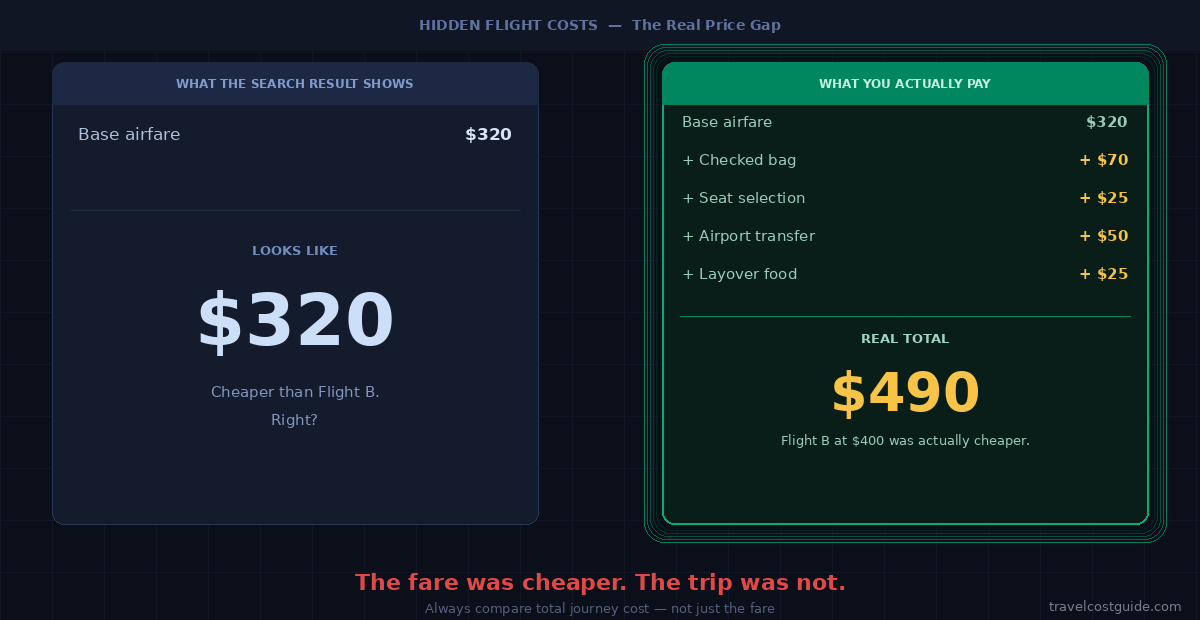
A cheap flight is not always a cheap trip.
The fare you see in search results is often just the starting point. Baggage fees, seat selection, airport transfers, layover costs, payment charges, and refund restrictions can quietly change the real price before you ever take off.
This is the next step after building your international trip budget: understanding the specific flight costs that can flip which option is actually cheaper. By the end of this guide, you’ll be able to run a full side-by-side flight comparison — base fare and everything underneath it.
The goal isn’t to avoid every add-on. Some are worth paying for. Some aren’t. What matters is knowing what you’re actually paying for before you click confirm.
Last updated: May 2026. Airline fees and passenger-rights rules change. Always confirm current terms with the airline or booking platform before purchasing.
How this guide was prepared: This guide focuses on practical pre-booking checks based on airline checkout logic, baggage and seat-fee patterns, and official passenger-rights resources including the U.S. Department of Transportation and European Commission air passenger rights guidance. Airline rules vary by route, country, fare type, and booking channel — always verify final terms directly before purchase.
1. Baggage Fees: The First Number to Check Before Comparing Fares
The most common hidden flight cost isn’t hidden at all — it’s just easy to overlook until checkout.
A fare that looks $40 cheaper can flip completely once you add a checked bag. On many budget carriers and basic economy fares, even a standard carry-on that won’t fit under the seat counts as a paid add-on.
I’ve made this mistake on a transatlantic booking. The base fare was $43 less than the alternative. The baggage page told a different story — two checked bags at $38 each way made the “cheaper” flight $109 more expensive in total.
Before comparing any two flights, check:
- Is a carry-on bag included, or is it paid?
- Is a checked bag included?
- What is the weight limit — and what does overweight cost?
- Is baggage cheaper to prepay online vs. at the airport?
- On connecting flights, do different airlines apply different baggage rules?
💡 Quick Rule: Never compare base fares alone. Compare fare plus the baggage you’ll actually need. Some carriers — including Spirit, Ryanair, and Frontier — use an unbundled pricing model, where the base fare covers the seat and little else. Bags, seat selection, and other services are priced and added separately.
The practical method: open the airline’s baggage fee page in a separate tab before you compare prices. What you find there changes the comparison more often than you’d expect.
2. Seat Selection Fees: Optional Until They’re Not
Seat selection feels like a pure optional extra. For a solo traveler on a 90-minute flight, skipping it probably doesn’t matter. But for families, couples traveling together, tall passengers, or anyone with a tight connection to catch, the “optional” fee can become a real problem.
Some airlines assign free seats at check-in. Others charge for every seat except the middle ones nobody wants. The gap between “free seat assignment” and “sit where we put you” can mean a lot, depending on your situation.
Ask yourself before skipping seat selection:
- Do I need to sit next to a child or traveling companion?
- Is this a long enough flight that comfort affects the trip?
- Do I have a tight connection where an aisle seat means a faster exit?
- Would paying for a higher fare class that includes seat selection cost less than adding it separately?
💡 If traveling with children: Check the airline’s family seating policy before booking. Policies differ significantly — some airlines seat families together automatically, others do not. Don’t assume. Check before you choose the cheapest fare class.
For passengers with disabilities or specific seating requirements, review the airline’s accommodation policy before booking, not after.
3. Airport Transfers: The Cost That Changes When You Land
A lot of travelers treat the taxi or train ride as a separate expense from the flight decision. It shouldn’t be.
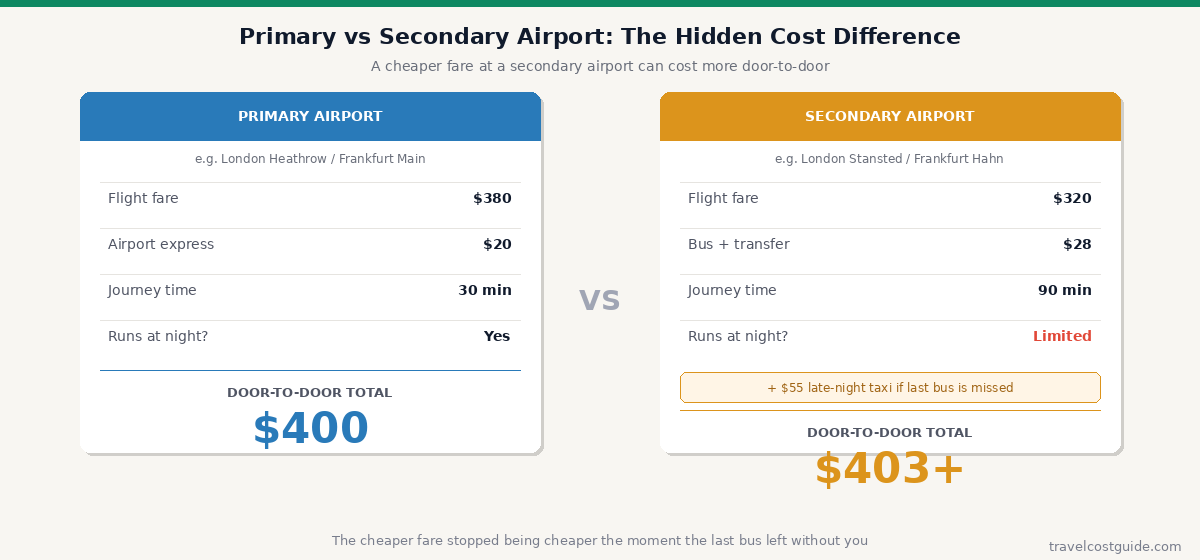
A flight landing at 11:30 p.m. might be $55 cheaper than the 6 p.m. option — but if the airport train has stopped running and the only option is a $70 rideshare, it’s not cheaper anymore. The same math applies to early-morning departures that force a pre-dawn ride or an airport hotel the night before.
This gets worse with secondary airports. Budget carriers — Ryanair and Wizz Air in Europe, Spirit and Frontier in the US — frequently route through airports that are 40 to 90 minutes from the city center. London Stansted is not London. Frankfurt Hahn is not Frankfurt. The fare is real. So is the two-hour bus ride.
Before choosing between flights, check:
- What time does the flight arrive or depart?
- Does public transport run at that hour?
- How far is the airport from your accommodation?
- Is this a primary airport or a secondary one?
- What does a late-night taxi or rideshare actually cost from that airport?
- Are airport express trains or buses bookable in advance?
💡 Practical Rule: When two flights are close in price, factor in airport-to-door cost, not just airport-to-airport. A $30 fare difference can disappear in a single taxi ride from the wrong airport at the wrong hour.
4. Layover Costs: When the Stopover Becomes a Budget Item
A four-hour layover at a budget airport with no lounge access, $14 sandwiches, and nothing free to drink is a cost. Not a huge one — but it adds up fast if you’re not expecting it.
Food is the main one. Long layovers, airport price premiums, and a couple of meals can run $30–$60 without feeling like spending. Add a coffee, bottled water, and a snack and you’re at $50 before you’ve left the terminal.
Before booking a connecting itinerary:
- How long is the layover?
- Are meals included on the flight?
- Is the layover airport known for expensive food?
- Does the layover extend overnight — requiring a hotel or additional transfers?
- Does the money saved over a direct flight actually exceed what you’ll spend during the stop?
Sometimes a slightly more expensive direct flight is the better deal once you price out the layover honestly. A $40 saving on a connecting fare can disappear into airport food and one coffee before the gate.
5. Payment and Booking Fees: The Costs That Appear at Checkout
This connects directly to how payment fees work when traveling abroad — the same mechanics apply when you’re still at home buying the ticket.
Some airlines add a service fee for paying by credit card. Booking platforms may add their own service charge on top. And if the airline charges in a foreign currency, your card may apply a foreign transaction fee you weren’t expecting.
There’s also dynamic currency conversion to watch for. Some booking platforms will offer to show the fare in your home currency. This sounds convenient but usually comes with a worse exchange rate than your bank would apply. If given the choice, pay in the currency the airline is charging in.
At the final checkout screen, check:
- Is there a payment or service fee?
- What currency is the fare charged in?
- Will your card charge a foreign transaction fee on this purchase?
- Is the site converting the fare to your home currency automatically — and is that rate favorable?
- Is the total lower if you book directly with the airline vs. through the platform?
💡 Quick check: The cheapest fare on a comparison site is sometimes not cheaper by the time the booking platform adds its fees. A quick check on the airline’s own website takes two minutes and occasionally saves real money.
6. Refund and Change Rules: The Hidden Cost You Pay Later
A non-refundable ticket is fine until your plans change. Then it becomes a cost you didn’t factor in.
On budget fares and basic economy tickets, changes may require a change fee plus the fare difference to the new date — sometimes totaling more than the original ticket. On some non-refundable fares, the only option is to walk away entirely.
I once held a non-refundable $210 ticket when a work conflict came up two weeks before departure. The change fee plus fare difference came to $190. I paid it. A travel insurance policy for that trip would have cost $28.
Before booking a non-refundable fare, review:
- Can the ticket be refunded — even partially?
- Can the date be changed, and at what cost?
- Is there a fare difference charge on top of the change fee?
- What happens if the airline changes the schedule?
- Did you book directly with the airline, or through a platform with its own change rules?
For flights to, from, or within the United States, the Department of Transportation outlines rules that may apply when airlines cancel or make significant changes. For EU-related flights, European Commission air passenger rights cover additional situations.
💡 The insurance question: If you’re booking non-refundable flights for a trip with any uncertainty — health, work, visa, weather — check whether travel insurance covers trip cancellation before deciding the non-refundable fare is worth the risk.
7. The True Cost of a Flight: A Side-by-Side Comparison
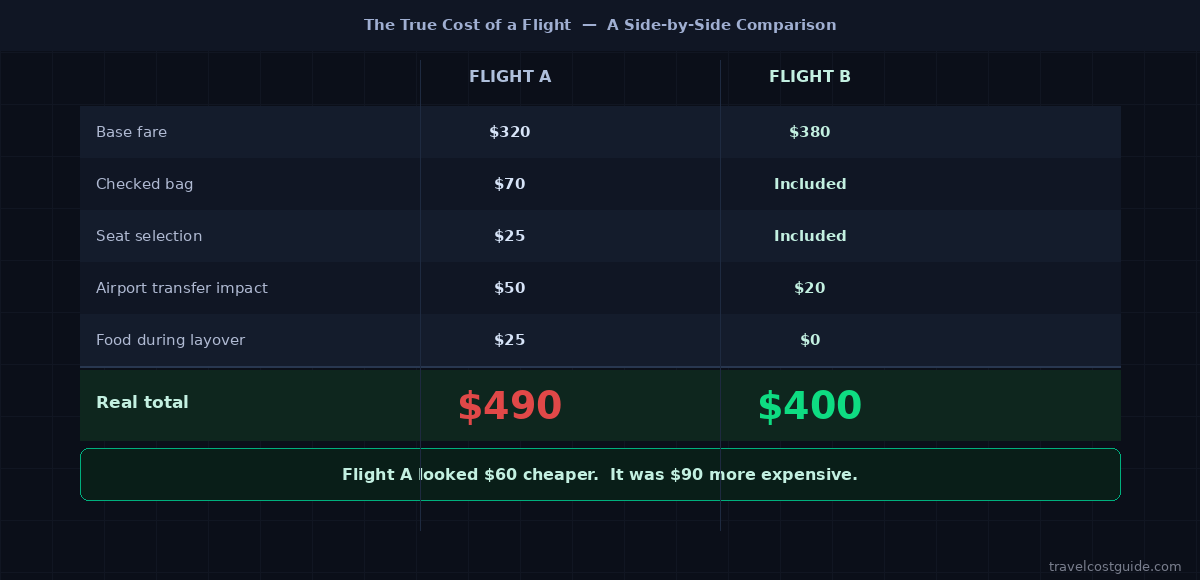
The cheapest fare is not always the cheapest flight. Here’s how to run the full comparison before you book.
| Cost Item | Flight A | Flight B |
|---|---|---|
| Base fare | $320 | $380 |
| Checked bag | $70 | Included |
| Seat selection | $25 | Included |
| Airport transfer impact | $50 | $20 |
| Food during layover | $25 | $0 |
| Real total | $490 | $400 |
Flight A looked $60 cheaper. It was $90 more expensive.
Build your own comparison:
- List the two or three flights you’re seriously considering
- Add baggage cost for the bags you’ll actually bring
- Add seat selection if you need it
- Add the realistic airport transfer cost at both ends
- Add any layover food or overnight costs
- Check payment method, currency, and fees on the final screen
The flight with the lowest total in that comparison is the one worth booking.
Where to Verify Flight Rules Before Booking
Because airline policies vary by route, fare class, and country, don’t rely only on a comparison site. Verify the most important terms from primary sources before paying:
- Airline baggage page — check exact fees for your fare type, not just the general policy
- Airline fare rules — refundability, change fees, fare difference rules, no-show conditions
- Final checkout screen — confirm total after all taxes, fees, and optional services
- Booking platform terms — if using an OTA, check who handles changes and refunds
- Official passenger-rights resources: U.S. DOT ticket-buying guidance and DOT refund guidance for U.S. flights; European Commission air passenger rights for EU flights
Frequently Asked Questions
Are baggage fees always charged separately?
Not always. Full-service carriers and premium fare classes typically include at least one checked bag. Budget carriers and basic economy fares typically do not. The only reliable way to know is to check the baggage rules for your specific fare type — not the airline’s general policy page, which may not apply to the cheapest ticket.
What is basic economy — and what does it usually exclude?
Basic economy is the lowest fare tier offered by many full-service airlines. It typically excludes seat selection, carry-on bag upgrades (sometimes carry-ons must fit under the seat only), and changes or refunds. It exists alongside regular economy on the same flight but with fewer included features. Always check what your specific basic economy fare includes before booking.
Is it cheaper to pay for baggage online or at the airport?
Almost always online and in advance. Most airlines charge significantly more for bags added at the airport check-in desk or gate. If you know you’ll need a checked bag, add it when you book or as soon as possible after.
What happens if the airline changes my flight?
If the airline makes a significant schedule change or cancels your flight, you may be entitled to a refund or rebooking depending on your route and the applicable rules. For U.S. flights, the DOT outlines when refunds are required. For EU flights, EC 261/2004 may apply. Check directly with your airline and the relevant passenger-rights authority for your specific situation.
Is travel insurance worth it for non-refundable flights?
For trips with any uncertainty — health issues, visa complications, work changes, or weather risk — travel insurance covering trip cancellation may be worth considering relative to what you stand to lose on a non-refundable booking. The calculation depends on how much you stand to lose and how likely a disruption is.
The Flight Cost Checklist
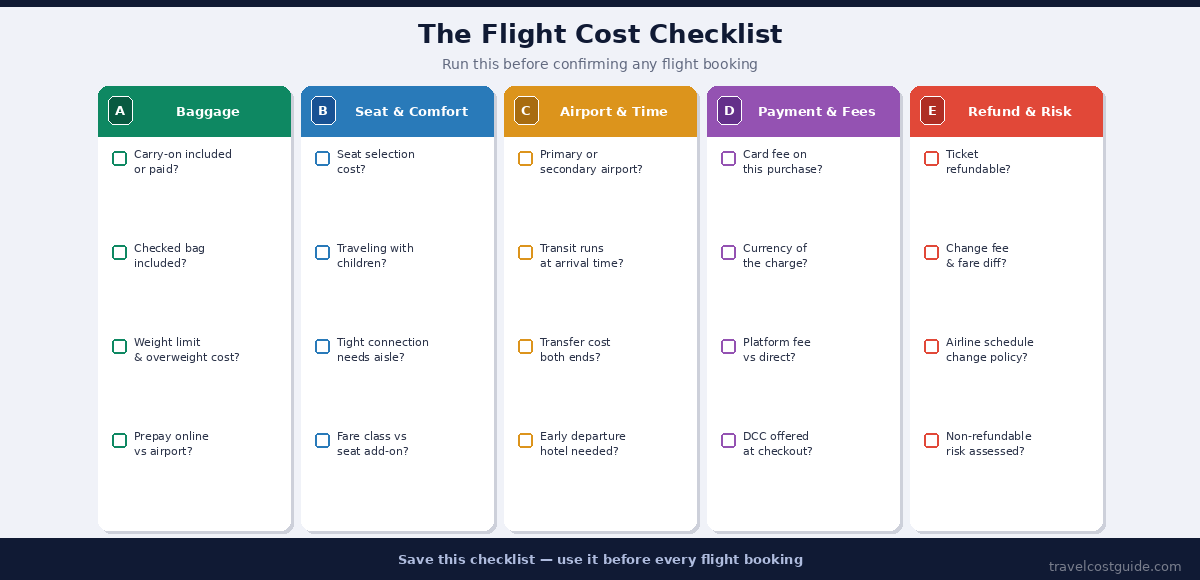
Before confirming any flight, run through this:
- Checked baggage rules confirmed for this exact fare?
- Carry-on allowance confirmed?
- Seat selection cost — or is it included?
- Arrival and departure time — do they create extra transfer costs?
- Primary or secondary airport?
- Layover length — does it add food or hotel costs?
- Payment method checked — card fees, foreign currency, DCC?
- Refundable or changeable — and at what cost?
- Booked direct or through a platform — who handles changes?
The Bottom Line
Hidden flight costs aren’t tricks. Most are just normal travel costs that don’t show up in the first price you see.
The fix is simple: compare flights by total journey cost — not fare alone. Add baggage, seats, airport transfers, layover spending, payment fees, and refund risk before deciding which ticket is cheapest. The fare was cheaper. Make sure the trip is too.
A realistic flight budget builds on your full international trip budget. The next step is understanding what happens to accommodation costs after you click through to the final booking screen.
Read next: Hotel Fees Nobody Tells You About Before You Book →