

I thought I had it all figured out.
Flight: booked. Hotel: reserved. Spending money: set aside. I even gave myself a $200 buffer, just in case.
Then I got to the airport.
Checked bag: $65 each way. Seat selection I’d skipped: $45. The taxi I didn’t plan for because the bus “runs every hour” — except not at 11 p.m. — another $55. By the time I reached my hotel and saw the $180 in taxes and resort fees at check-in, my “budget trip” had quietly become something else entirely.
Here’s what I learned: the price you see when you first search is almost never the price you actually pay.
This guide walks you through how to estimate the real cost of an international trip before you book — not just the headline numbers, but every layer that builds up beneath them. Use it before you hit “confirm” on anything.
Why Your First Estimate Is Almost Always Wrong
Most travelers start (and stop) with three numbers: flight, hotel, and a rough daily allowance.
That’s not a budget. That’s a wishlist.
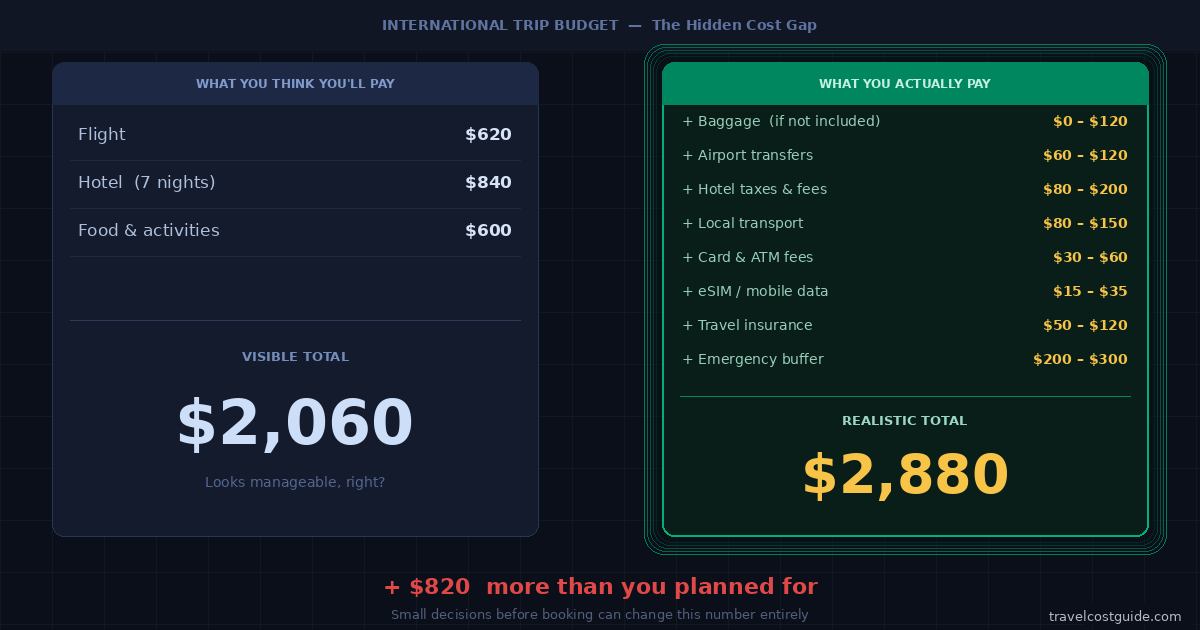
Here’s a quick example. Say you’re planning a 7-night trip and your first pass looks like this:
| Category | Estimated Cost |
|---|---|
| Flight | $620 |
| Hotel (7 nights) | $840 |
| Food & activities | $600 |
| Visible total | $2,060 |
Looks manageable, right? Now here’s what that estimate often gets wrong — some of these will apply to your trip, others may not. The problem is most people don’t check until after they’ve already booked:
| Often-Missed Cost | Typical Range |
|---|---|
| Checked baggage, if not included in fare | $0–$120 |
| Airport transfers (both ends) | $60–$120 |
| Hotel taxes, resort & service fees | $80–$200 |
| Local transportation | $80–$150 |
| Foreign transaction & ATM fees | $30–$60 |
| eSIM or mobile data | $15–$35 |
| Travel insurance | $50–$120 |
| Emergency buffer | $200–$300 |
| Realistic added cost | $575–$1,105 |
That same trip? Depending on which of these apply to your booking, the real total often lands somewhere between $2,500–$3,200.
The goal of this guide isn’t to scare you off traveling — it’s to make sure you’re comparing real numbers, not just the ones that look good in a search result.
The 7-Part Framework for Estimating Your True Trip Cost
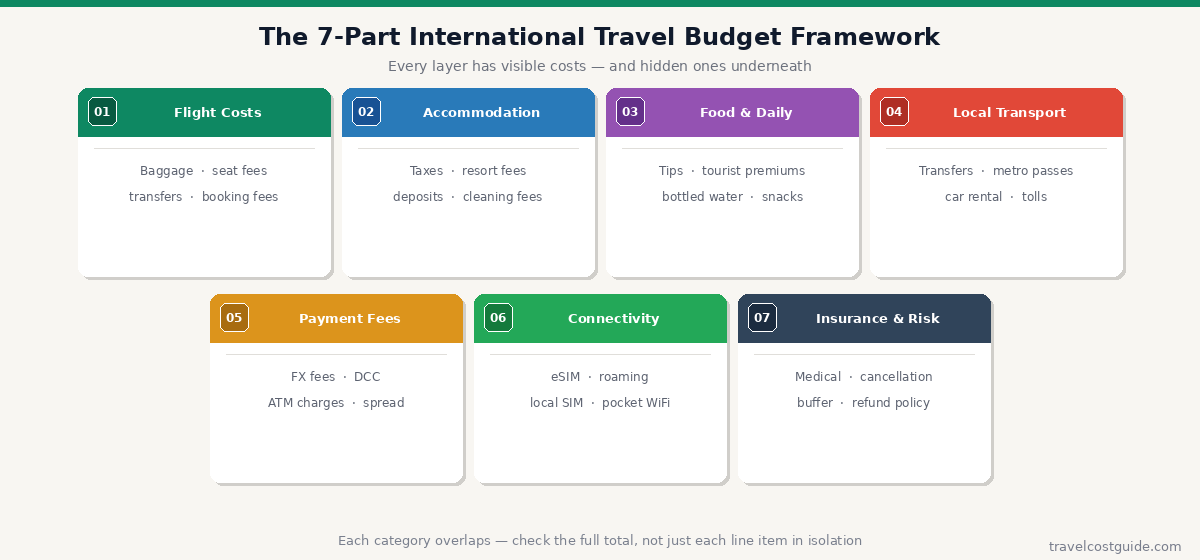
Think of your international travel budget in seven layers. Each one has visible costs — and hidden ones underneath.
1. Flight Costs Beyond the Ticket Price
The base fare is just the starting point.
On full-service carriers or certain fare classes, checked bags may already be included — which means this line item is $0 for you. On budget carriers or basic economy fares, it can add $60–$120 or more for a round trip. The point isn’t that baggage always costs extra. It’s that you need to know before you compare fares, not after you’ve already booked.
I once booked what I thought was a $180 round-trip flight. After bags, a seat selection (the middle seat next to the lavatory was free — everything else cost extra), and a $15 “payment processing fee,” it came to $310. Still decent — but not what I thought I was booking.
Before you confirm any flight, check:
- Whether baggage is included — and if not, exactly what it costs
- Seat selection costs (especially on budget carriers)
- Meal inclusion on long-haul flights
- Payment or booking fees
- Airport transfer costs at both ends
- Refund and change policies
💡 Pro Tip: Budget airlines look cheap until you add bags. Always open the airline’s baggage fee page before comparing fares. Sometimes a $40-more expensive ticket on a full-service carrier is actually cheaper once bags are included.
Want a full breakdown of every fee airlines charge before and after booking? The Hidden Flight Costs Travelers Often Forget →
2. The True Cost of Accommodation
Room rate comparisons are nearly useless without the final total.
Taxes, resort fees, destination fees, cleaning fees, and service charges can add 20–40% on top of the advertised nightly rate — and they’re often not shown until the last step of checkout.
Always check:
- All taxes and mandatory fees
- Cleaning or service fees (especially for short-term rentals)
- Security deposit requirements
- Breakfast inclusion (or cost)
- Cancellation deadline and refund terms
- Parking, if you’ll have a car
💡 Quick Rule: Never compare “rate vs. rate.” Always click through to the final payment screen and compare total payable amounts. A $110/night room with $45/night in fees beats a $130/night room with no fees — but not by as much as it first appeared.
Also worth thinking about: a cheaper hotel far from the city center may save $20/night on the room but cost $30/day in extra transport. Do the full math.
For a complete guide to hotel taxes, resort fees, and how to compare the real cost of any property: Hotel Fees Nobody Tells You About Before You Book →
3. Building a Realistic Daily Travel Budget
Food is the category most people underestimate — and the one that varies most.
Rather than picking a single daily number and hoping for the best, try this three-scenario approach:
| Day Type | What It Looks Like | Example Budget |
|---|---|---|
| Light day | Street food, local spots, cooking at accommodation | $25–$35 |
| Normal day | Mix of sit-down meals, one coffee stop, light snacking | $45–$65 |
| Splurge day | Nice dinner, tourist area lunch, drinks | $80–$120 |
Multiply your “normal day” estimate by your full trip length, then swap in two or three “splurge days” where you know you’ll spend more — arrival day, a special dinner, a day tour.
Don’t forget to factor in:
- Tips and service charges (varies significantly by country)
- Bottled water (surprisingly adds up in hot climates)
- Coffee or drinks you’d normally grab without thinking
- Airport and tourist-zone price premiums (often 50–100% higher)
4. Local Transportation: The Cost That Hides in Plain Sight
Getting around once you’re there is often the budget item people think least about in advance.
Depending on where you’re going and how you like to travel, local transport can be minimal — or it can rival your accommodation cost.
Think through:
- Airport arrival and departure transfers (taxi, train, bus, rideshare)
- City metro or bus passes vs. per-ride costs
- Intercity trains or buses if you’re moving between cities
- Taxis or rideshare for late nights or areas without good transit
- Car rental, fuel, tolls, and parking if driving
💡 The Accommodation-Transport Trade-off: If you’re staying outside the city center to save money, run the full numbers. A hotel that’s $30 cheaper per night but requires two $15 rideshares per day is actually costing you more. Location has a real price — sometimes it’s worth paying.
5. Hidden Fees When Paying Abroad
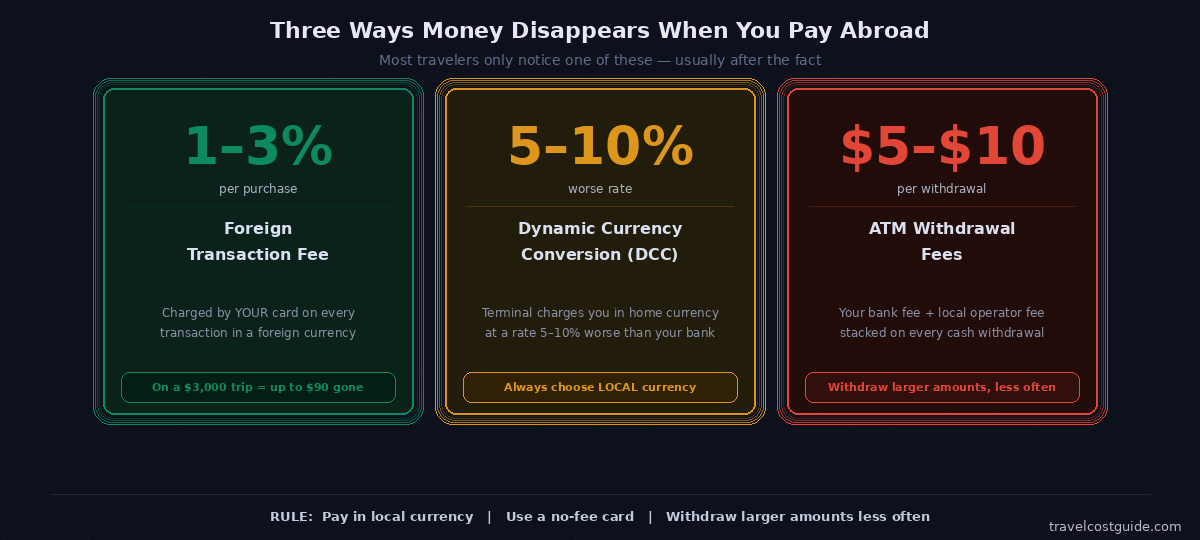
This is the category where money disappears quietly — and it’s entirely avoidable with a little preparation. I once paid $340 for a €300 hotel room because I let the terminal charge me in dollars. The exchange rate the hotel’s card machine offered was 13% worse than my bank’s rate. That’s $40 gone in a single tap — before I’d even left the lobby.
The issue isn’t just “exchange rates.” It’s the multiple layers of fees stacked on top of each transaction.
Watch out for:
- Foreign transaction fees — many cards charge 1–3% on every purchase abroad
- Dynamic currency conversion (DCC) — when a card terminal offers to charge you in your home currency, almost always say no; their exchange rate is typically worse
- ATM withdrawal fees — your bank’s fee, plus the local ATM operator’s fee, sometimes $5–10 per withdrawal
- Cash exchange spread — airport exchange desks often have poor rates
Before you travel:
- Check your card’s foreign transaction fee policy
- Know which card you’ll use for hotels, daily purchases, and ATM withdrawals
- Research whether your destination is mostly cash or card-based
Some travelers use cards specifically designed for international use to eliminate most of these fees. Whether that’s worth it depends on your trip length and spend volume.
Go deeper on each of these: How to Avoid Foreign Transaction Fees Abroad → — and — What Is Dynamic Currency Conversion — and When to Decline It →
For ATM fees, bank charges, and cash withdrawal costs abroad:
ATM Fees Abroad: What to Check Before Withdrawing Cash →
6. Connectivity: Your Data Plan Is Part of Your Budget
A few years ago, this was a minor line item. Now it’s essential — especially if you’re relying on maps, translation apps, mobile payments, or banking apps while abroad.
Your options:
| Option | Best For | Approximate Cost |
|---|---|---|
| eSIM (pre-purchase online) | Most travelers | $10–$35 for 7–14 days |
| Local SIM on arrival | Longer stays | $10–$25 + top-ups |
| International roaming (your carrier) | Short trips, convenience | $10–$15/day (varies widely) |
| Pocket WiFi rental | Groups, heavy users | $8–$15/day |
⚠️ Don’t skimp if connectivity matters: If you need reliable access for banking apps, two-factor authentication, work calls, or navigation in unfamiliar areas, prioritize reliability over cost. Getting stranded without data in an unfamiliar city isn’t a savings — it’s a stress tax.
eSIM vs. roaming vs. local SIM — which is actually cheaper for your trip? eSIM vs International Roaming: A Real Cost Comparison →
7. Travel Insurance and Your Emergency Buffer
Most people either skip this entirely or buy a policy without really understanding what it covers. Both are mistakes.
What to think through:
- Does your existing health insurance cover you internationally? (Many don’t, or cover very little)
- Are your major bookings refundable if your plans change?
- What’s your exposure if you need to cancel, delay, or cut the trip short?
- What would a medical emergency abroad actually cost you?
You don’t necessarily need the most comprehensive plan. But you do need to make a conscious decision — not just skip it because it feels like an extra expense.
A basic travel insurance policy for a week-long international trip often runs $40–$100 — a fraction of what a single missed flight or minor medical visit abroad could cost.
Also budget for an emergency cash buffer. A reasonable rule of thumb: 10–15% of your total estimated trip cost, set aside and untouched unless something actually goes wrong.
See what travel insurance actually costs — and what it does and doesn’t cover: Travel Insurance Costs: What You’re Actually Paying For →
For cancellation rules, refund paths, chargebacks, and what to check before paying:
Booking Refunds: What Travelers Should Check Before Paying →
The Pre-Booking Checklist: Run This Before You Confirm Anything
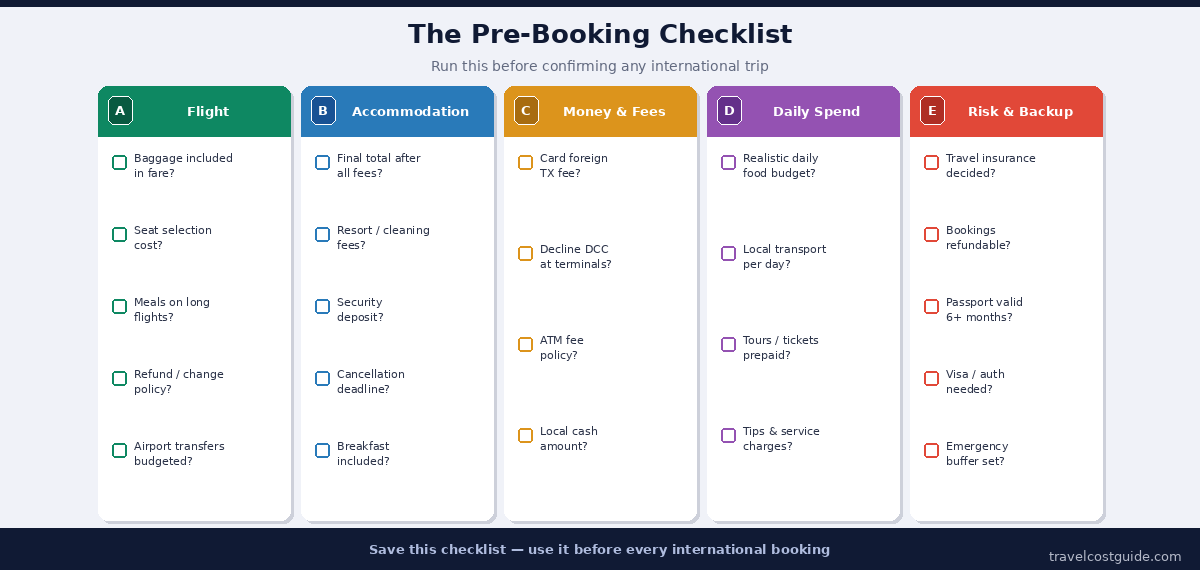
Bookmark this or save it to your travel planning folder — it’s the checklist to run through before booking every international trip.
Save this. Use it every time.
✈️ Flight
- Is baggage (checked and carry-on) included in the fare?
- What does seat selection cost?
- Are meals included on long flights?
- What’s the refund or change policy?
- Have I factored in airport transfers at both ends?
🏨 Accommodation
- What is the final total after all taxes and fees?
- Are there resort, destination, cleaning, or service fees?
- Is a deposit required — and when is it returned?
- What is the cancellation deadline?
- Is breakfast included or an additional cost?
💳 Money & Payments
- Which card will I use for hotel payments, daily purchases, and ATMs?
- Does my card charge foreign transaction fees?
- Do I know to decline dynamic currency conversion?
- How much local cash should I carry?
🍜 Daily Spending
- What’s my realistic per-day food budget (not the optimistic one)?
- How much will local transportation cost per day?
- Are tours, tickets, or activities paid in advance?
- Will tips or service charges apply at most places?
🛡️ Risk & Backup
- Have I decided on travel insurance — and actually understood what it covers?
- Are my major bookings refundable if needed?
- Is my passport valid for at least 6 months beyond my return date?
- Do I need a visa or travel authorization?
- Have I set aside an emergency buffer?
Spend More Upfront, Spend Less Overall
Here’s the counterintuitive truth about travel budgeting: trying to minimize every individual cost often leads to a more expensive trip.
A hotel 40 minutes from the city center might save $25/night — but cost $40/day in transport. A non-refundable fare might save $60 — but expose you to a $400 loss if your plans shift. A “free” card might charge 3% foreign transaction fees that quietly add $90 to a $3,000 trip.
The goal isn’t to spend as little as possible on each line item. The goal is to understand the full picture before you commit — then make decisions with all the numbers in front of you.
Some upgrades are genuinely worth it. Some cheap options are genuinely cheap. The only way to know the difference is to do the actual math.
Frequently Asked Questions
How much should I budget for an international trip?
It depends heavily on destination, trip length, and travel style — but a useful rule is to take your initial flight + hotel estimate and add 30–40% to cover the costs most first estimates miss. For a 7-night trip from the U.S., realistic totals often range from $2,500 to $5,000+ depending on destination.
What are the most commonly overlooked travel costs?
The biggest surprises tend to be: checked baggage fees, hotel taxes and resort fees, airport transfers, foreign transaction and ATM fees, and travel insurance. Together, these can easily add $400–$800 to a trip that appeared cheaper on first search.
Is travel insurance worth it for international trips?
For most international trips — especially those with non-refundable bookings, international health care gaps, or activities with some risk — yes. The cost is usually modest relative to what it protects against. The decision should be intentional, not a default skip.
How do I avoid hidden fees when paying abroad?
Use a card with no foreign transaction fees, always pay in local currency when given the choice (not your home currency), and research ATM fee policies before you go. These three habits alone can save $50–$150 on a typical international trip.
What is dynamic currency conversion, and should I avoid it?
Dynamic currency conversion (DCC) is when a foreign card terminal offers to charge you in your home currency instead of the local one. It sounds convenient, but the exchange rate used is almost always significantly worse than your bank’s rate — sometimes by 5–10%. The rule: always choose to pay in the local currency. If the terminal defaults to your home currency, ask the cashier to rerun it in local currency before you sign.
Do I need an eSIM for international travel?
Not always — but it’s often the most cost-effective option for stays of 3 or more days. An eSIM lets you activate a local data plan without swapping physical SIMs. For a 7-day trip, a prepaid eSIM typically costs $10–$25, compared to $10–$15 per day for carrier roaming. If you rely on maps, banking apps, or two-factor authentication while traveling, having reliable data matters more than saving a few dollars on the cheapest option.
The Bottom Line
The real cost of international travel isn’t one number on a booking site — it’s the sum of everything you commit to before you leave.
Slow down before you hit confirm. Build your budget in layers: visible costs first, then hidden costs, then risk costs, then a realistic buffer. It takes maybe 20 extra minutes. What it buys you is the ability to make real decisions — not just hopeful ones.
A realistic budget isn’t a pessimistic budget. It’s a prepared one.
Start with the next step: The Hidden Flight Costs Travelers Often Forget Before Booking →
Or jump ahead to the full system: Pre-Booking Checklist: What to Review Before You Pay →