The flight is selected. The hotel looks good. The dates work. The price seems reasonable. You may already have your passport nearby, your card ready, and a browser tab open with the final checkout page.
This is the moment when many hidden travel costs become easier to miss.
A flight may have baggage fees. A hotel may have resort fees or a strict cancellation deadline. Your card may add foreign transaction fees. The checkout page may show a currency conversion option that costs more than expected. Your phone plan may trigger roaming charges after arrival. Your insurance may not cover the reason you are most worried about. Your booking may be non-refundable if plans change.
This pre-booking checklist is designed to help international travelers pause before paying. It does not guarantee that a trip will be cheaper, refundable, or problem-free. Instead, it gives you a practical review system for flights, hotels, payment fees, ATM access, mobile data, travel insurance, booking refunds, documents, and final checkout details.
Important note: Travel rules, refund rights, insurance terms, card fees, airline policies, hotel conditions, and entry requirements can change. This article is general travel cost information, not legal, financial, medical, or insurance advice. Confirm current terms with the airline, hotel, booking platform, card issuer, insurer, government travel authority, and relevant official sources before paying.
How this guide was prepared: This checklist was developed using publicly available information from government travel agencies, transport regulators, consumer protection agencies, and official travel resources. No airline, hotel, online travel agency, card issuer, insurer, eSIM provider, or travel product has sponsored or influenced this content.
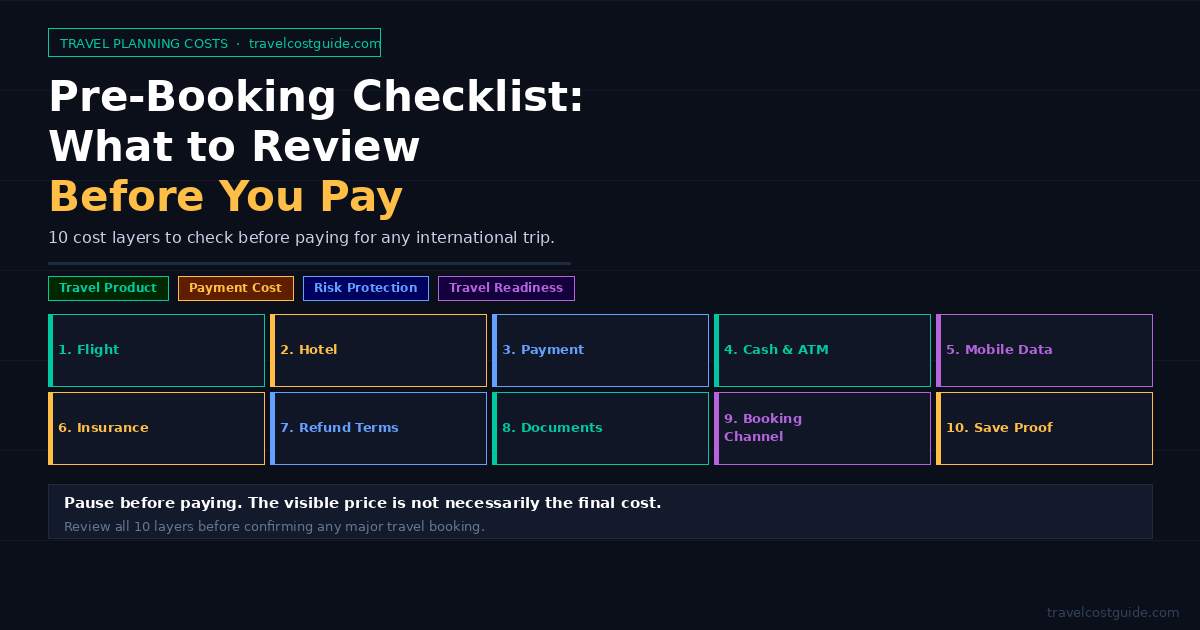
Pause before paying. The visible price is not necessarily the final cost.
Why a Pre-Booking Checklist Matters
Most travel cost mistakes do not happen because travelers ignore the big price. They happen because the final price is spread across several layers.
The base flight fare may not include checked baggage. The hotel rate may not show every local fee until later. The “pay in your home currency” button may include dynamic currency conversion. A cheaper prepaid hotel rate may have stricter refund terms. A travel insurance policy may help only if the reason for cancellation is covered. A phone roaming pass may activate when you did not expect it.
A pre-booking checklist helps you review these layers before the payment is final. The goal is not to make every trip perfect. The goal is to understand what you are agreeing to before the money leaves your account.
If you want the full cost framework first, start with The Real Cost of an International Trip — Before You Book. That guide explains how flights, hotels, payments, mobile data, insurance, refunds, and local costs combine into the real trip budget.
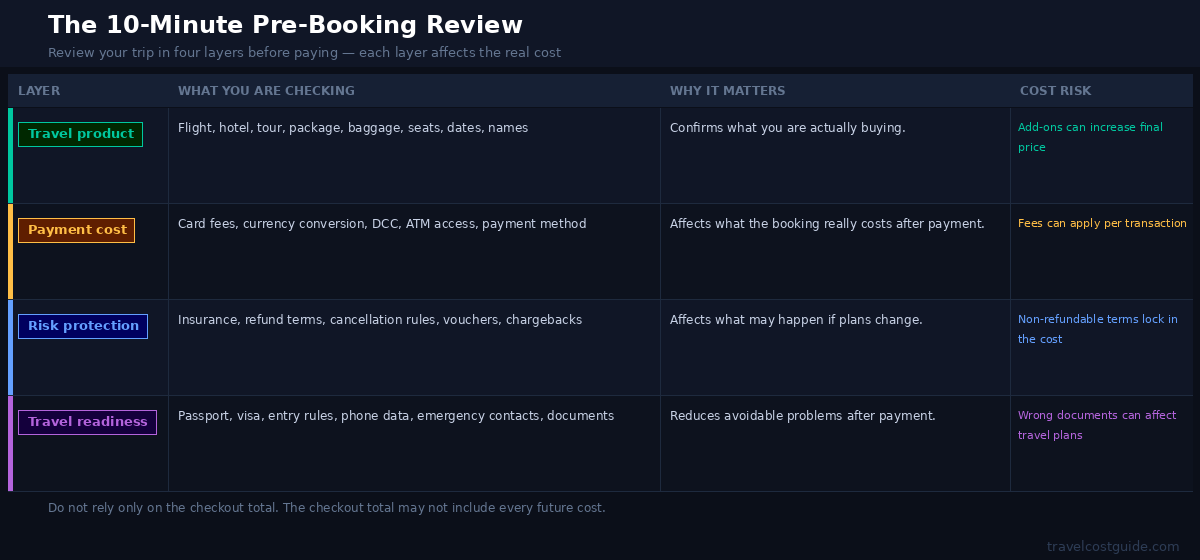
The 10-Minute Pre-Booking Review
Review travel products, payment costs, risk protection, and travel readiness before paying.
Do not rely only on the checkout total. The checkout total may not include every future cost. The checklist below helps you look beyond the visible price.
1. Check the Flight Before You Pay
Flight prices can look simple until the add-ons appear. A low fare may become less attractive after baggage, seat selection, payment fees, airport transfers, schedule risk, or change rules are included.
Before paying for a flight, check:
whether checked baggage is included;
whether carry-on baggage has weight or size limits;
whether seat selection costs extra;
whether the ticket allows changes;
whether the fare is refundable, partially refundable, credit-only, or non-refundable;
whether the connection time is realistic;
whether separate tickets create extra risk if one flight is delayed;
whether the arrival airport is the one you expected;
whether airport transfers add meaningful cost;
whether names match passport details exactly.
If the flight is cheap because it is highly restricted, that may still be fine for some travelers. The key is knowing what the restriction means before you pay.
A hotel price can also be more complicated than it looks. The nightly rate may not include taxes, resort fees, destination fees, cleaning fees, deposits, parking, breakfast, early check-in, late checkout, or local charges collected at the property.
Before paying for a hotel, check:
whether the displayed rate includes taxes and mandatory fees;
whether resort fees, destination fees, or cleaning fees are charged separately;
whether the booking is prepaid or paid at the property;
whether the hotel requires a deposit or card hold;
whether breakfast, parking, Wi-Fi, or shuttle service is included;
whether the cancellation deadline is based on hotel local time;
whether the first night, deposit, or full stay becomes non-refundable;
whether the room type, bed type, and occupancy rules match your trip;
whether local taxes or city fees are payable after arrival;
whether the booking platform or the hotel handles changes and refunds.
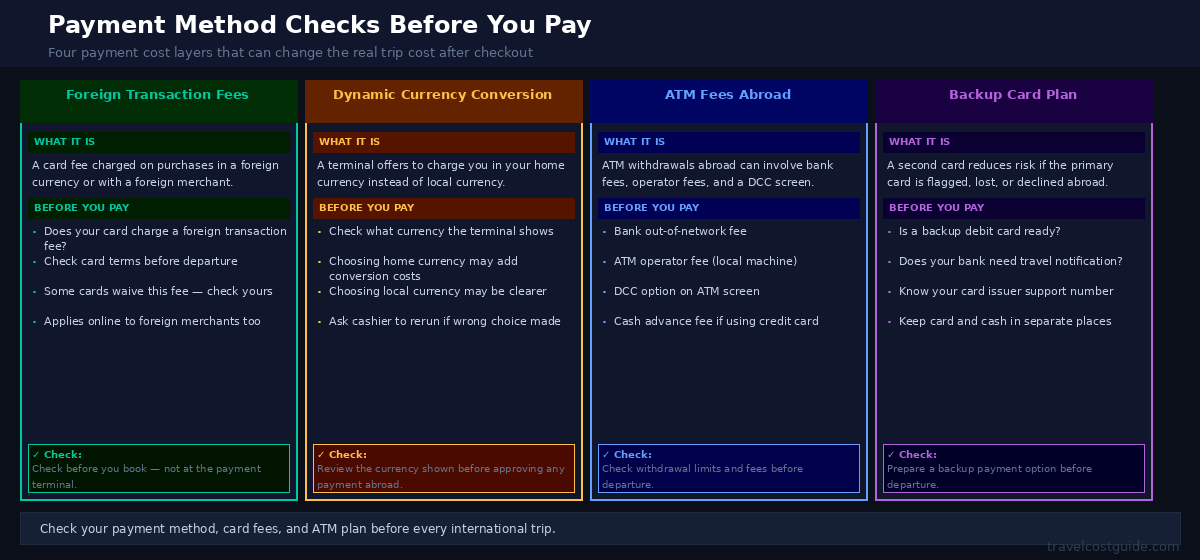
Payment method can affect the real trip cost through foreign transaction fees, currency conversion, DCC choices, ATM fees, and card rules.
Your payment method can change the real cost of a trip. This is especially true when booking in a foreign currency, paying a foreign merchant, withdrawing cash abroad, or using an ATM that offers currency conversion.
Before paying, check:
whether your card charges foreign transaction fees;
whether the merchant is based in another country;
whether the checkout currency is your home currency or the merchant’s local currency;
whether a dynamic currency conversion option appears;
whether your card network or issuer handles currency conversion;
whether your card issuer adds a separate international processing fee;
whether the card has travel protections that apply only if you pay with that card;
whether the card has enough available credit for hotel deposits or holds;
whether your bank may flag the payment as unusual;
Even if most of your trip is card-based, cash can still matter. Some destinations, small restaurants, local transport, markets, tips, deposits, or emergency situations may require cash. But withdrawing cash abroad can involve several fee layers.
Before departure, check:
whether your destination is card-friendly or cash-heavy;
whether your debit card works internationally;
whether your bank charges out-of-network ATM fees;
whether ATM operators at the destination may charge their own fee;
whether daily withdrawal limits are enough for your trip;
whether ATM screens may offer dynamic currency conversion;
whether your credit card cash advance fee and interest would apply if used for cash;
whether you need a backup debit card;
whether your bank requires travel notification;
whether you know what to do if an ATM keeps your card.
Your phone setup can affect both convenience and cost. A travel eSIM may be useful for data, but some plans are data-focused and may not include traditional calls or SMS. International roaming may keep your home number active, but the cost depends on your carrier, plan, destination, and usage.
Before paying for a trip, check:
whether your phone supports eSIM;
whether your phone is carrier-unlocked;
whether your destination is covered by your eSIM or roaming plan;
whether you need your home number for banking or work verification;
whether SMS codes are required for credit cards, email, or travel accounts;
whether mobile hotspot is allowed under your plan;
whether your home SIM could trigger roaming charges in the background;
whether you need Pocket WiFi for a group or multiple devices;
whether Wi-Fi calling works internationally under your carrier’s rules;
whether you have offline maps, hotel addresses, and emergency contacts saved.
Mobile data is not only about convenience. It can matter if you need to contact an airline, hotel, insurer, bank, ride app, or emergency service after arrival. For a full comparison, read eSIM vs International Roaming: A Real Cost Comparison.
6. Check Travel Insurance Before You Rely on It
Travel insurance can be useful, but it should not be treated as a general refund guarantee. A policy may help with certain covered reasons, eligible medical expenses, evacuation, baggage, delays, or trip interruption, depending on the policy wording.
Before buying or relying on travel insurance, check:
which cancellation reasons are covered;
whether trip cancellation and trip interruption are separate benefits;
whether emergency medical coverage applies at your destination;
whether medical evacuation is included;
whether pre-existing medical conditions are excluded or require a waiver;
whether planned activities are excluded;
whether deductibles and benefit limits match your trip risk;
whether baggage, delay, or missed connection benefits have sub-limits;
whether you need to contact emergency assistance before treatment or evacuation;
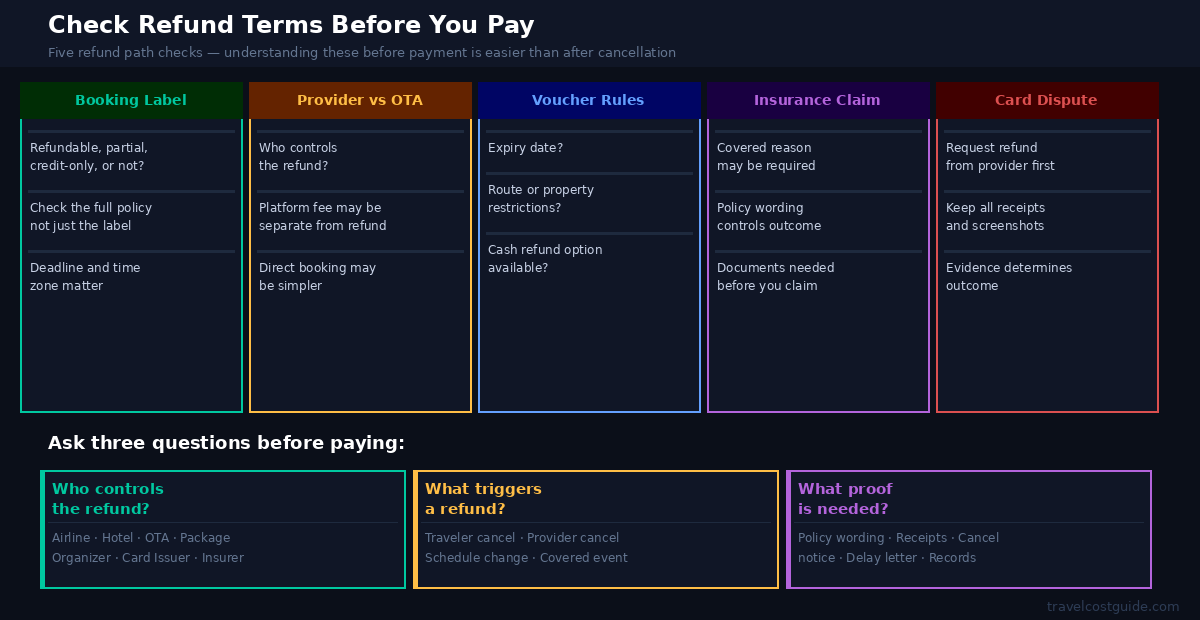
Before paying, check refund labels, provider rules, voucher terms, insurance claim conditions, card dispute paths, and required proof.
Refund terms are easier to understand before payment than after cancellation. Once you pay, your options may depend on the booking label, provider terms, payment method, insurance policy, passenger rights, or package travel rules.
Before paying, check:
whether the booking is refundable, partially refundable, credit-only, or non-refundable;
whether the cancellation deadline is based on local time;
whether taxes, deposits, fees, and add-ons are refundable;
whether no-show rules differ from cancellation rules;
whether the airline, hotel, OTA, or package organizer controls the refund;
whether a voucher is optional or the default option;
whether the voucher has expiration dates or route restrictions;
whether local passenger or package travel rules may apply;
whether a card dispute could be relevant if the service is not provided;
what screenshots and documents you should save before paying.
Some travel costs come from booking the right trip with the wrong documents. Passport validity, visa requirements, electronic travel authorizations, vaccination documentation, onward tickets, proof of accommodation, and local entry rules can affect whether you can board a flight or enter the destination.
Before paying, check:
whether your passport is valid for the required period after arrival;
whether blank passport pages are required;
whether a visa or electronic travel authorization is required;
whether the visa processing time fits your travel dates;
whether the destination requires onward or return travel proof;
whether vaccination or health documentation is required;
whether children need additional consent or documents;
whether your name appears consistently across passport, tickets, visas, and bookings;
whether local laws or entry conditions affect your planned activities;
whether official government travel advice has changed recently.
Entry requirements can change, so verify them through official government and destination sources before paying for non-refundable travel.
9. Check Your Booking Channel and Support Path
Where you book can affect how problems are handled. Booking directly with an airline, hotel, or tour operator may make communication simpler. Booking through an online travel agency may offer comparison tools or bundled pricing, but refunds and changes can involve multiple parties.
Before paying, check:
who collects the payment;
who issues the confirmation;
who handles changes;
who handles refunds;
whether the platform charges a service fee;
whether customer support is available in your time zone;
whether support is by phone, chat, email, or app only;
whether the provider can help directly if you booked through a third party;
whether the same booking has different terms on the provider’s own website;
whether you have saved the support contact details.
The cheapest booking channel is not necessarily the easiest one to manage if a change, cancellation, or refund request becomes necessary.
10. Save Proof Before You Click Pay
Documentation is one of the most practical ways to reduce confusion later. It may not guarantee a refund, claim, or dispute result, but it can help show what terms applied when you paid.
Before paying, save:
the checkout page showing the total price;
fare rules or room rate rules;
cancellation and refund policies;
screenshots of deadlines and time zones;
taxes, fees, baggage, seat, resort, or service charge details;
voucher or credit terms;
insurance policy documents;
card benefit terms if you rely on credit card protection;
provider contact details;
confirmation emails and payment receipts.
After booking, store these documents in a folder you can access from your phone. Keep offline copies of essential items in case you lose mobile data access.
Final Pre-Booking Checklist
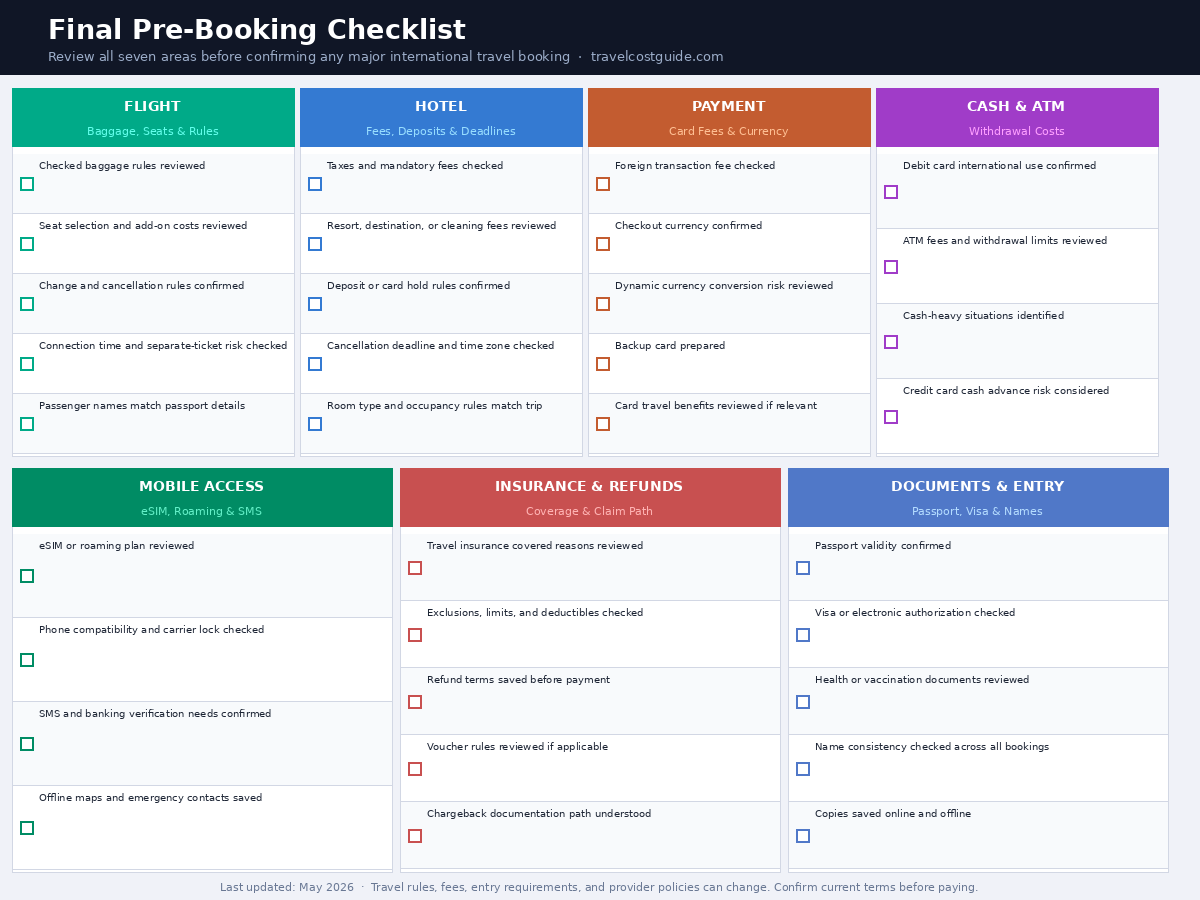
Use this final checklist to review flights, hotels, payment fees, cash access, mobile data, insurance, refunds, documents, and entry requirements before paying.
Use this final checklist before you confirm any major travel booking.
Flight
☐ Baggage rules checked
☐ Seat selection and add-on costs checked
☐ Change and cancellation rules reviewed
☐ Connection time and separate-ticket risk checked
☐ Passenger names match passport details
Hotel
☐ Taxes and mandatory fees checked
☐ Resort, destination, cleaning, or local fees checked
☐ Deposit or card hold rules checked
☐ Cancellation deadline and time zone checked
☐ Room type, occupancy, and included amenities checked
Payment
☐ Foreign transaction fee checked
☐ Checkout currency checked
☐ Dynamic currency conversion risk checked
☐ Backup card prepared
☐ Card travel benefits reviewed if relevant
Cash and ATM
☐ Debit card international use checked
☐ ATM fees and withdrawal limits reviewed
☐ Cash-heavy situations identified
☐ Credit card cash advance risk considered
Mobile Access
☐ eSIM or roaming plan reviewed
☐ Phone compatibility and carrier lock checked
☐ SMS and banking verification needs checked
☐ Offline maps and emergency contacts saved
Insurance and Refunds
☐ Travel insurance covered reasons reviewed
☐ Exclusions, limits, and deductibles checked
☐ Refund terms saved before payment
☐ Voucher rules reviewed if applicable
☐ Chargeback and dispute documentation path understood
Documents and Entry
☐ Passport validity checked
☐ Visa or electronic authorization checked
☐ Health or vaccination documents checked if relevant
☐ Name consistency checked across all bookings
☐ Copies saved online and offline
Frequently Asked Questions
What should I check before booking an international trip?
Before booking, check flight rules, hotel fees, cancellation deadlines, payment currency, foreign transaction fees, insurance terms, refund conditions, passport validity, visa requirements, and mobile data access. The goal is to understand both the upfront price and the possible extra costs before paying.
Is the cheapest booking usually the best choice?
Not necessarily. A cheaper booking may have stricter cancellation terms, no baggage allowance, fewer support options, higher change fees, or limited refund rights. A lower price can still be a good choice if the restrictions match your trip plans, but it should be compared against the full cost and risk.
Should I book directly or through an online travel agency?
Both options can work. Direct booking may make changes and refunds simpler because you deal with the provider directly. An online travel agency may offer useful comparison tools or bundled prices, but support and refund handling can involve both the OTA and the provider. Check the terms before choosing.
Should I buy travel insurance before or after booking?
Timing can matter. Some travel insurance benefits, such as certain pre-existing condition waivers or optional cancellation upgrades, may require purchase within a specific period after the first trip payment. Check policy timing requirements before relying on a benefit.
What screenshots should I save before paying?
Save the final price, cancellation policy, refund terms, baggage rules, hotel fee breakdown, voucher rules, insurance terms, booking conditions, and confirmation page. These records can help if the booking page changes or if you later need to request support.
Do I need to check passport and visa rules before paying?
Yes, especially for international trips. Entry requirements can affect whether you can board a flight or enter the destination. Check passport validity, visa or electronic authorization rules, health documents, and name consistency before paying for non-refundable travel.
What if I am not sure whether a booking is refundable?
Do not rely only on the label. Read the full cancellation policy, refund terms, deadline, time zone, provider rules, and payment conditions. If the terms are unclear, contact the provider or booking platform before paying and save the written response.
Bottom Line
A pre-booking checklist is not about making travel complicated. It is about slowing down before the payment step, when small details are still easier to fix.
Before you pay, review the flight, hotel, payment method, cash plan, mobile access, insurance, refund terms, documents, and support path. A few minutes of checking can help you understand the real cost of the trip more clearly.
The lowest visible price is not necessarily the final cost. Taxes, fees, baggage, deposits, exchange rates, ATM charges, roaming, insurance exclusions, and refund conditions can all affect what the trip really costs.
A better booking is not only one that looks affordable today. It is one with costs, rules, documents, and backup options you understand before you confirm payment.
Where to Verify
Before paying for major travel bookings, verify current information through official sources and provider documents:
Last updated: May 2026. Travel prices, refund rules, entry requirements, card fees, insurance terms, mobile data plans, and provider policies can change. Confirm current terms directly with official sources and the provider before paying.