You find the perfect flight. The hotel looks good. The tour has limited availability. The price is lower than expected.
Then you see the small line near the checkout button:
Non-refundable.
For many travelers, that single phrase becomes important only after plans change. A flight is canceled. A visa is delayed. A family emergency happens. A hotel booking turns out to have stricter cancellation terms than expected. A tour operator offers credit instead of cash. An online travel agency says the airline or hotel controls the refund.
This guide explains booking refunds from a practical travel cost perspective. It does not provide legal advice, does not guarantee any refund outcome, and does not recommend a specific airline, hotel, online travel agency, card issuer, insurance company, or booking platform. Instead, it explains what travelers should check before paying so they understand where a refund may come from — and where it may not.
Important note: Refund rights and refund processes can depend on the provider, country, booking channel, fare rules, hotel policy, package terms, payment method, travel insurance policy, and timing of cancellation. Read the terms before paying and confirm current rules with the airline, hotel, travel agency, tour operator, card issuer, or insurer involved in your booking.
How this guide was prepared: This guide was developed using publicly available information from transport regulators, consumer protection agencies, government travel resources, and payment dispute guidance. No airline, hotel, online travel agency, card issuer, insurer, or travel product has sponsored or influenced this content.
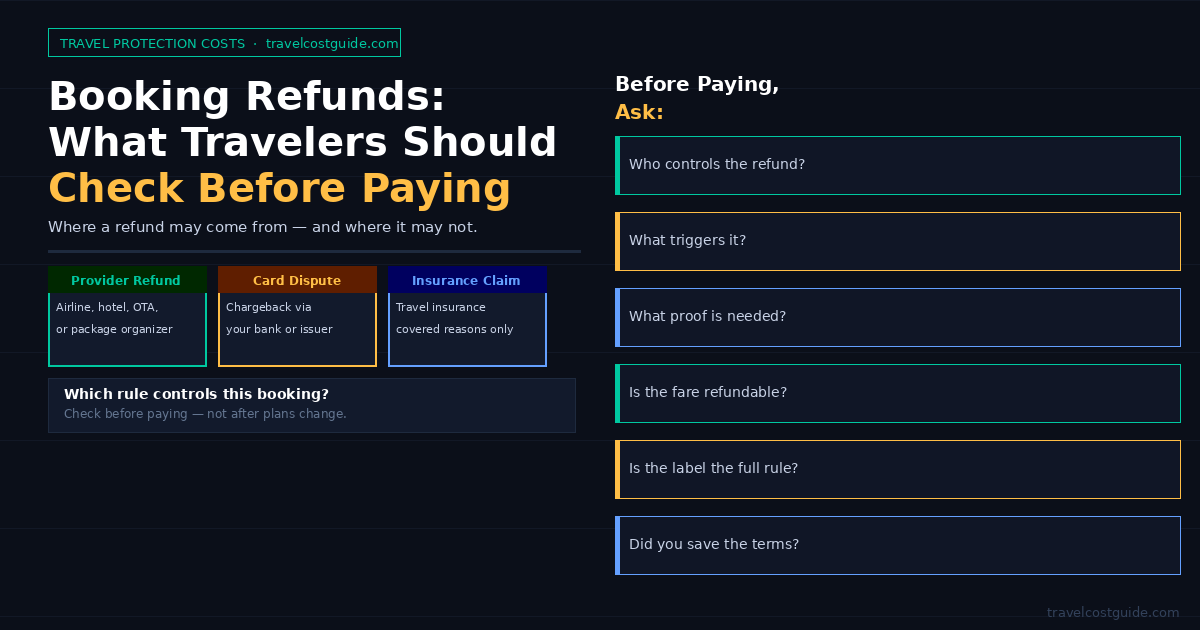
Before paying, travelers should ask who controls the refund, what triggers it, and what proof may be needed.
Booking Refunds Are Not One Simple Rule
A common refund mistake is assuming that every travel booking follows the same rule. In reality, a flight refund, hotel refund, package holiday refund, tour refund, travel credit, chargeback, and travel insurance claim are different things — and they follow different rules.
A refund may come directly from the provider that sold the booking. It may come from an airline or hotel even if you booked through a third party. It may come through a package travel organizer. It may be handled as a card dispute. It may be a travel insurance claim. It may also be offered as a voucher or future travel credit instead of cash, depending on the terms and applicable rules.
The main question is not only, “Can I get my money back?” The more useful question is: Which rule controls this booking, and what evidence would I need if something goes wrong?
Booking refunds are part of the larger trip cost picture. If you are still planning the full budget, The Real Cost of an International Trip — Before You Book explains how flights, hotels, payment fees, mobile data, insurance, and booking terms can all affect the total cost of travel.
Refundable vs Non-Refundable: What the Label May Mean
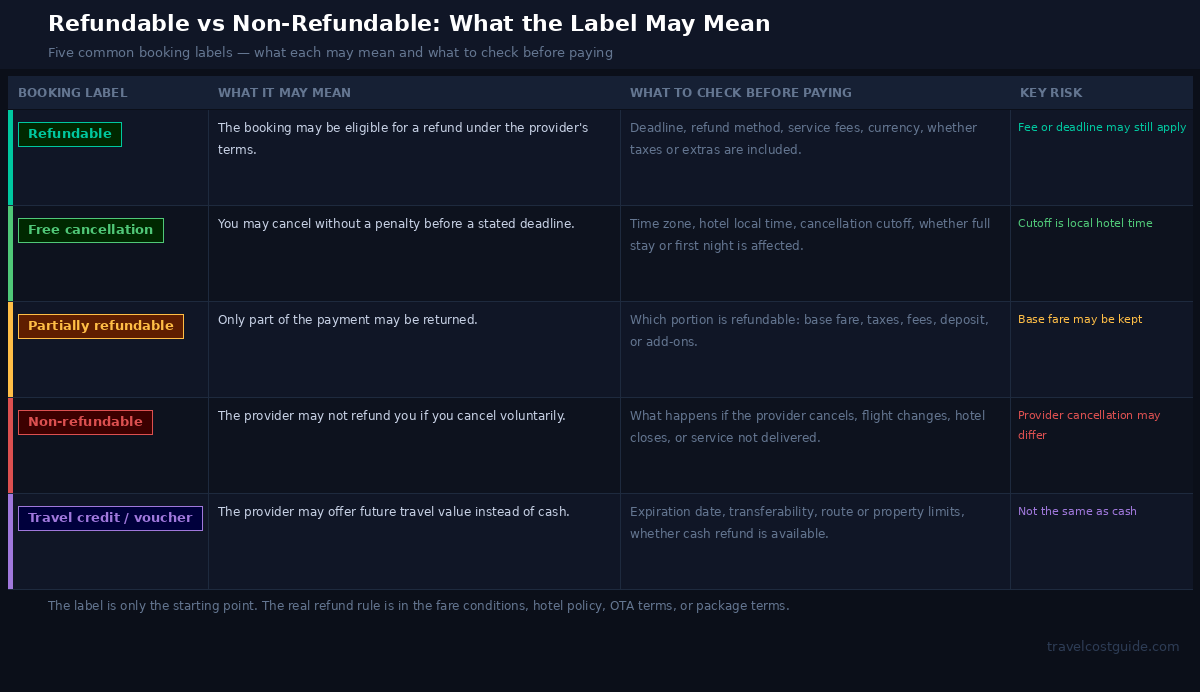
Booking labels such as refundable, free cancellation, partially refundable, non-refundable, and travel credit are only the starting point.
Travel booking pages often use simple labels such as “refundable,” “free cancellation,” “partially refundable,” or “non-refundable.” These labels are useful, but they do not always explain the full conditions.
A refundable booking may still have a deadline, processing time, service fee, currency conversion issue, or partial cancellation rule. A free cancellation hotel rate may only be free until a specific local time at the hotel’s destination. A partially refundable fare may return taxes but not the full base fare. A non-refundable booking may still have different rules if the provider cancels the service — but that depends on the booking type and applicable law.
Booking Label
What It May Mean
What to Check Before Paying
Refundable
The booking may be eligible for a refund under the provider’s terms.
Deadline, refund method, service fees, currency, and whether taxes or extras are included.
Free cancellation
You may be able to cancel without a penalty before a stated deadline.
Time zone, hotel local time, cancellation cutoff, and whether the full stay or first night is affected.
Partially refundable
Only part of the payment may be returned.
Which portion is refundable: base fare, taxes, fees, deposit, or add-ons.
Non-refundable
The provider may not refund you if you cancel voluntarily.
What happens if the provider cancels, the flight changes, the hotel closes, or the service is not delivered.
Travel credit or voucher
The provider may offer future travel value instead of cash.
Expiration date, transferability, route or property limits, blackout dates, and whether a cash refund is available.
The label is only the starting point. The real refund rule is in the fare conditions, hotel cancellation policy, package terms, OTA terms, voucher rules, or insurance policy wording.
Flight Refunds: Airline Cancellation vs Traveler Cancellation
Flight refunds can be confusing because the reason for cancellation matters. A traveler canceling voluntarily is different from an airline canceling or significantly changing the flight — and the applicable rules can be different too.
If you cancel your own flight, the refund depends on the fare rules. Some fares may be refundable. Some may allow a credit. Some may return only taxes or fees. Some may charge a cancellation fee. Basic economy or promotional fares may have stricter rules than flexible fares.
If the airline cancels the flight or makes a significant schedule change, different refund rights may apply depending on the country, route, airline, and passenger protection rules. In the United States, the Department of Transportation explains that consumers may be entitled to a refund if an airline cancels a flight or significantly delays or changes a flight and the consumer chooses not to travel or accept alternatives offered by the airline.
In the European Union, air passenger rights may provide options such as reimbursement, rerouting, and assistance in certain cancellation, delay, denied boarding, or missed connection situations. The rules depend on the flight, route, airline, and specific circumstances.
Before paying for a flight, check:
whether the fare is refundable, partially refundable, or non-refundable;
whether changes are allowed and what fees or fare differences may apply;
what happens if the airline cancels the flight;
what happens if the airline changes the schedule, route, airport, or connection;
whether baggage, seat selection, or other extras are refundable if not provided;
whether you booked directly with the airline or through an online travel agency;
how refunds are processed if you paid with points, miles, vouchers, or mixed payment methods.
Hotel Refunds: Free Cancellation Is About the Deadline
Hotel refund rules often depend on the cancellation deadline. A room may be listed as “free cancellation” at the time of booking but become non-refundable after a certain date and time. That cutoff is usually based on the hotel’s local time zone — not your home time zone.
Hotels may offer several rate types for the same room. A flexible rate may cost more but allow cancellation before a deadline. A prepaid rate may cost less but carry stricter refund terms. A non-refundable rate may charge the full stay immediately or shortly after booking.
Before booking a hotel, check:
the exact cancellation deadline and which time zone it applies to;
whether the first night, deposit, or full stay becomes non-refundable;
whether taxes, resort fees, destination fees, or service charges are refundable;
whether a no-show charge differs from a standard cancellation charge;
whether payment is collected now or at the property;
whether the hotel or the booking platform processes the refund;
whether the policy changes during holidays, peak seasons, events, or promotional rates.
A hotel refund problem can also be a fee problem. Some properties add resort fees, destination fees, cleaning fees, local taxes, or deposits that may have separate rules. For a fuller breakdown, read Hotel Fees Guide: What Travelers Should Check Before Booking.
Online Travel Agencies: Who Actually Controls the Refund?
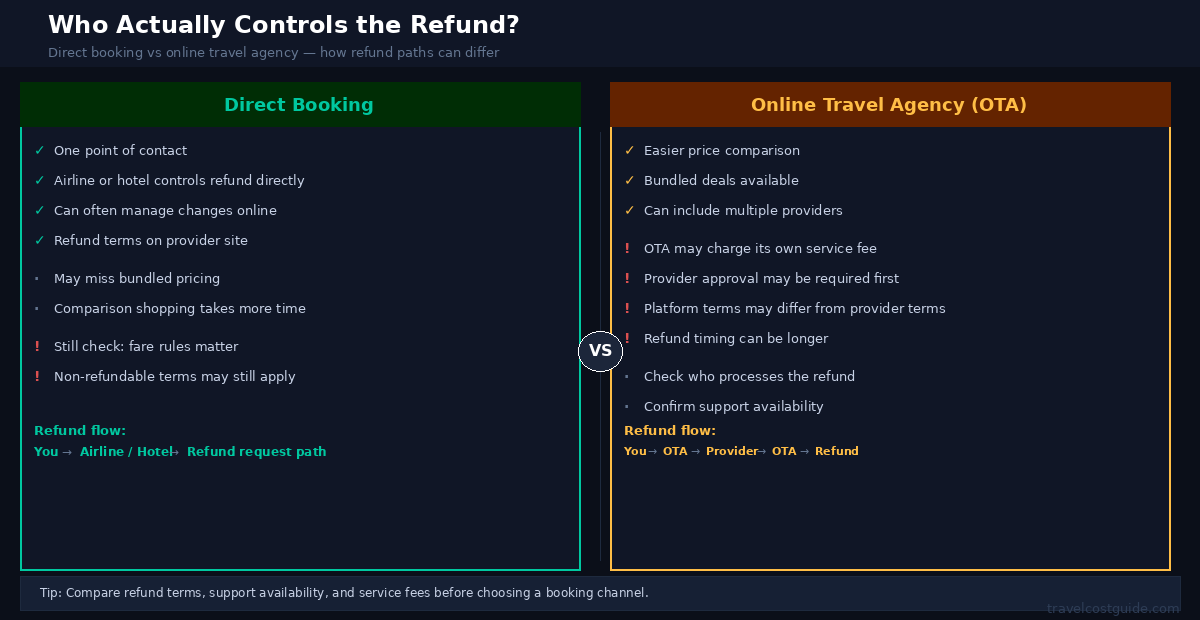
Refund handling can differ depending on whether the booking is made directly with the provider or through an online travel agency.
Online travel agencies can make comparison shopping easier, but refund handling can become complicated when several parties are involved. You may pay the OTA, but the airline, hotel, car rental company, or tour operator may control part of the cancellation rule.
In some cases, the OTA collects payment and processes the refund directly. In others, the OTA forwards the request to the airline or hotel. Sometimes the provider approves the refund but the platform needs additional time to process it. Sometimes the platform’s own fee is separate from the provider refund. Sometimes the OTA’s terms are stricter than the provider’s direct booking terms.
Before booking through an OTA, check:
whether the OTA or the provider processes refunds;
whether the OTA charges its own cancellation or service fee;
whether provider approval is required before the OTA processes your refund;
whether you can manage changes directly with the airline or hotel;
whether customer support is available in your language and time zone;
whether refund timing is clearly explained in the booking terms;
whether the same booking has different refund terms on the provider’s own website.
The U.S. Federal Trade Commission advises travelers to obtain a copy of cancellation and refund policies before paying. This is especially useful when booking through platforms, resellers, or third-party agencies where multiple parties may be involved in a refund.
Package Trips, Tours, and Bundled Bookings
Package trips and bundled travel products may have different refund rules from booking flights and hotels separately. A package may include flight, hotel, transfers, tours, excursions, cruise elements, or local services under one organizer or platform.
In some regions, package travel laws can give travelers specific protections if the organizer cancels the trip. For example, UK government guidance states that when package holiday organizers cancel a holiday, customers are entitled to a full refund within 14 days of the cancellation date. EU package travel rules may also include refund protections in certain package cancellation situations, though specific rights depend on the current law and how the trip was booked.
If you cancel voluntarily, different rules may apply. The organizer may charge a termination fee, and that fee can increase as the departure date approaches. Some deposits may be non-refundable. Some tours or excursions included in the package may have separate supplier terms.
Before buying a package or tour, check:
whether the booking is legally treated as a package, linked travel arrangement, or separate services;
what happens if the organizer cancels the trip;
what happens if you cancel voluntarily and when fees apply;
whether deposits are refundable;
whether cancellation fees increase closer to the departure date;
whether vouchers are optional or required under the organizer’s terms;
whether financial protection applies if the organizer becomes insolvent;
whether flights, hotels, and tours have separate cancellation rules within the package.
Vouchers and Travel Credits: Not the Same as Cash
A voucher or travel credit can be useful if you plan to book again with the same provider. But it is not the same as a cash refund, and the conditions can matter if your travel plans are uncertain.
Vouchers can have expiration dates, blackout dates, route limits, property restrictions, name restrictions, transfer limits, and currency restrictions. A voucher may not cover taxes, fees, baggage, seat selection, resort fees, or price differences on a future booking. If the future trip is more expensive, you may need to pay the difference.
Before accepting a voucher, check:
whether a cash refund is available instead;
the voucher expiration date;
whether the voucher can be transferred to another person;
whether it applies to any route, hotel, or date;
whether unused value remains after partial use;
whether taxes and fees can be paid with the voucher;
what happens if the provider changes ownership, closes, or stops operating.
Some travelers accept vouchers quickly because the offer appears convenient. Before accepting, compare the voucher rules against the cash refund option — especially when future travel plans are uncertain.
Travel Insurance and Booking Refunds
Travel insurance can be relevant to booking refunds, but it should not be confused with the provider’s own refund policy — they are separate and follow different rules.
A provider refund is based on the airline, hotel, OTA, tour operator, or package organizer’s terms and any applicable passenger or consumer protection rules. A travel insurance claim is based on the insurance policy’s covered reasons, exclusions, limits, deductibles, and required documentation.
For example, a non-refundable hotel booking may not be refundable by the hotel if you cancel voluntarily. A travel insurance policy may help only if the reason for cancellation is a covered event under the policy. If the reason is not covered — or if the required documents cannot be provided — the insurance claim may not result in payment even if the booking was expensive.
Before relying on travel insurance for booking refund situations, check:
which cancellation reasons are covered by the policy;
whether trip interruption is separate from trip cancellation;
whether pre-existing medical conditions affect coverage;
whether “cancel for any reason” is available and what percentage may be reimbursed;
whether the policy covers supplier default or insolvency;
what receipts, medical records, provider letters, or cancellation proof are required;
whether the claim must be filed within a specific period after the incident.
Chargebacks and Card Disputes: A Backup, Not a Shortcut
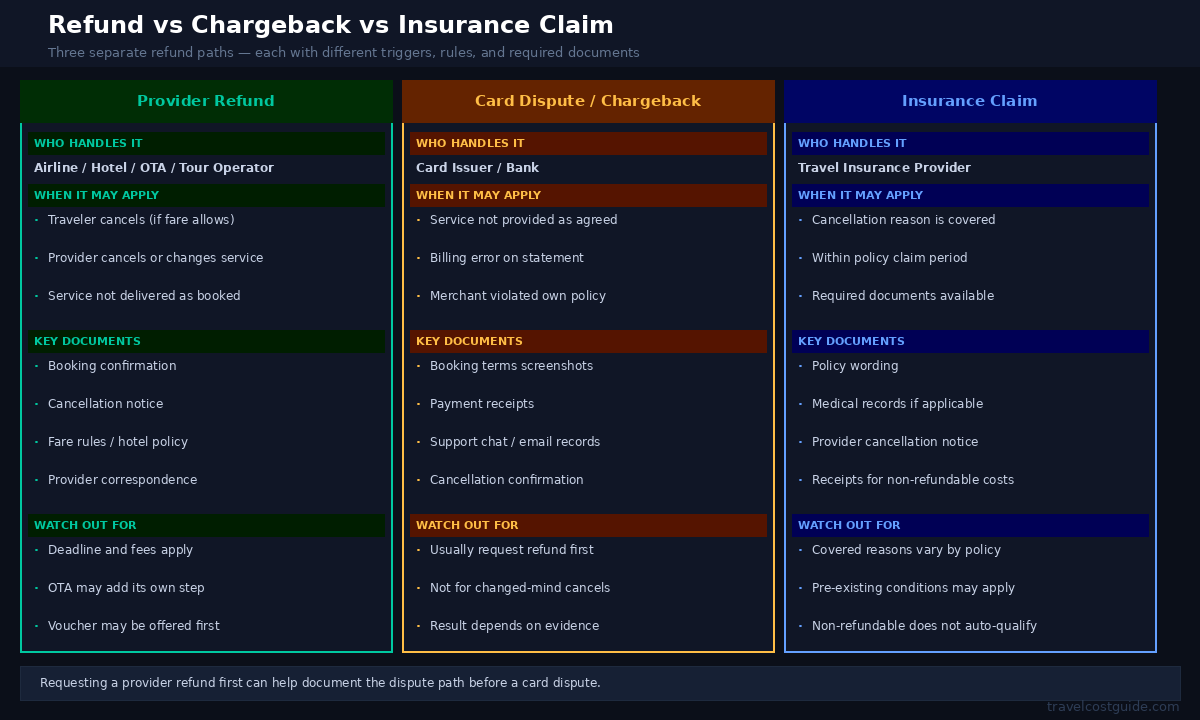
Provider refunds, card disputes, and travel insurance claims are separate processes with different triggers, rules, and required documents.
A chargeback or card dispute can be useful in certain situations, but it is not a guaranteed refund tool. It is also not the same as canceling a booking under the provider’s own terms.
A refund usually comes from the merchant or travel provider. A chargeback is a payment dispute handled through your card issuer or bank. It may be relevant if a service was not provided, a merchant did not honor its stated terms, or there was a billing error. It may not apply simply because you changed your mind about a non-refundable booking.
In the United States, the Fair Credit Billing Act provides protections for certain credit card billing errors, and the FTC explains that credit card billing errors generally need to be disputed in writing within 60 days of the statement showing the error. In other countries, chargeback rules and consumer protections can differ by card network, bank, and local law.
Before starting a card dispute, consider:
whether you first requested a refund directly from the provider;
whether the provider failed to deliver the service as agreed;
whether the charge differs from what you agreed to pay;
whether the provider violated its own stated refund policy;
whether you have receipts, screenshots, cancellation confirmations, and support records;
whether the dispute deadline has passed;
whether the booking terms clearly stated non-refundable at the time of purchase.
A card dispute may temporarily credit your account while the issuer investigates, but the final result depends on the evidence submitted, card network rules, local law, and the merchant’s response. Keep documentation before, during, and after any dispute process.
The best time to prepare for a potential refund problem is before payment — not after. Once a booking page changes or a provider removes the terms, it can be difficult to prove what conditions applied when you paid.
Before paying, save:
the full cancellation policy;
fare rules or room rate rules;
screenshots of refund labels and cancellation deadlines;
the checkout page showing taxes, fees, and add-ons;
confirmation emails and payment receipts;
voucher or credit terms if applicable;
insurance policy documents if you buy coverage;
provider contact details and any support chat records.
After a cancellation or disruption, save:
airline cancellation or disruption notices;
hotel cancellation confirmations;
delay or disruption letters from the carrier;
refund request confirmation numbers;
support emails or chat transcripts;
card dispute documents and case numbers;
insurance claim forms and claim reference numbers;
bank or card statements showing the original charge and any refund received.
Documentation does not guarantee a refund outcome, but it can clarify the process if you need to contact the provider, file an insurance claim, or dispute a charge with your card issuer.
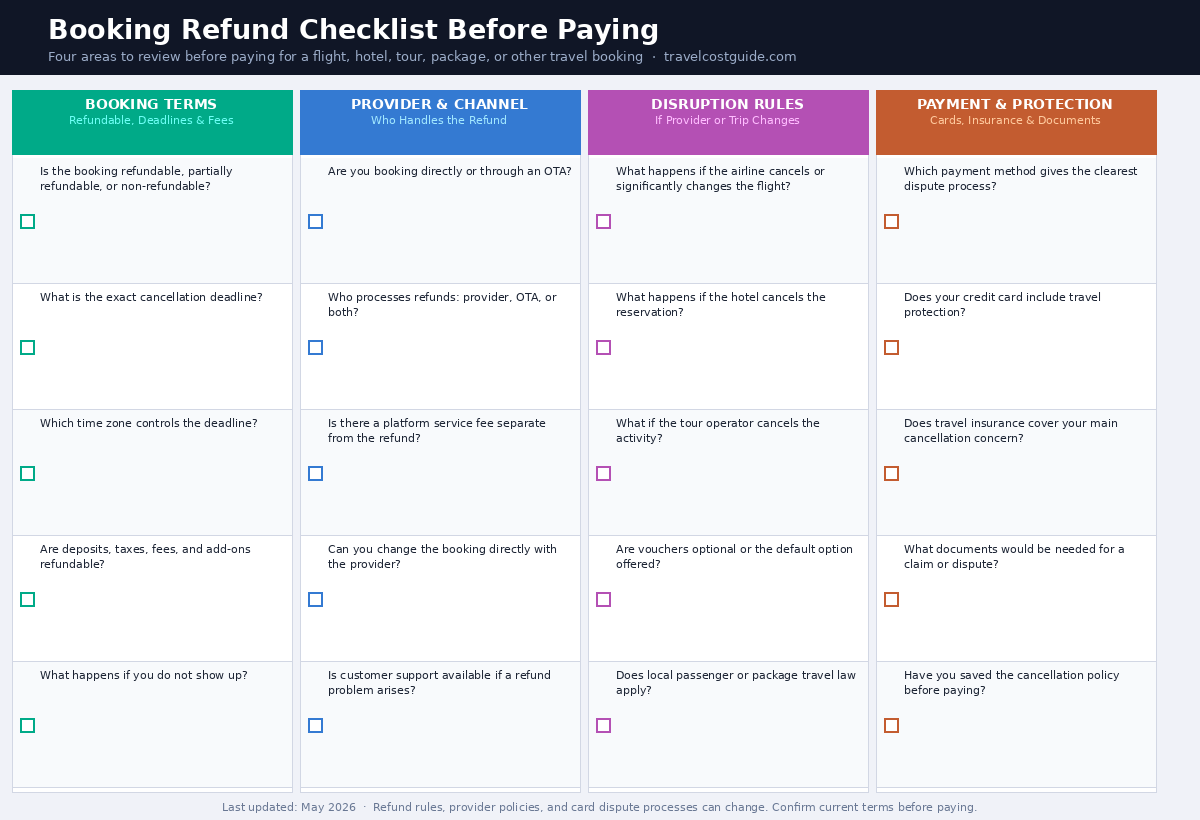
Booking Refund Checklist Before Paying
Before paying, check booking terms, provider refund paths, disruption rules, payment protection, and documents you may need later.
Use this checklist before paying for a flight, hotel, tour, package, or other travel booking.
Booking Terms
☐ Is the booking refundable, partially refundable, or non-refundable?
☐ What is the exact cancellation deadline?
☐ Which time zone controls the deadline?
☐ Are deposits, taxes, fees, and add-ons refundable?
☐ What happens if you do not show up?
Provider and Booking Channel
☐ Are you booking directly or through an online travel agency?
☐ Who processes refunds: the provider, the OTA, or both?
☐ Is there a platform service fee that is separate from the provider refund?
☐ Can you change the booking directly with the airline, hotel, or tour operator?
☐ Is customer support available if a refund problem arises?
Disruption Rules
☐ What happens if the airline cancels or significantly changes the flight?
☐ What happens if the hotel cancels the reservation?
☐ What happens if the tour operator cancels the activity?
☐ Are vouchers optional or the default option offered?
☐ Does local passenger or package travel law apply to this booking?
Payment and Protection
☐ Which payment method gives the clearest dispute process if needed?
☐ Does your credit card include any relevant travel protection?
☐ Does travel insurance cover the cancellation reason you are concerned about?
☐ What documents would be needed for an insurance claim or card dispute?
☐ Have you saved the cancellation policy and booking terms before paying?
Frequently Asked Questions
Are non-refundable bookings ever refundable?
Sometimes, but it depends on the booking type, provider terms, reason for cancellation, applicable law, and whether the provider or the traveler initiated the cancellation. A non-refundable booking usually means the provider may not refund you if you cancel voluntarily. Different rules may apply if the provider cancels the service or fails to deliver what was purchased.
Should I book directly or through an online travel agency for easier refunds?
Direct booking can simplify communication because you deal with the airline, hotel, or tour operator directly. An OTA can still be useful for comparison shopping or bundled rates, but refund handling may involve both the platform and the provider. Compare refund terms, support availability, and service fees before deciding.
Is a voucher the same as a refund?
No. A cash refund returns money to the original payment method or another approved route. A voucher or travel credit keeps value with the provider for future use and may carry expiration dates, usage restrictions, transfer limits, and route or property limitations.
Can travel insurance refund a non-refundable booking?
Travel insurance may help only if the cancellation reason is covered by the policy and the required documents are provided. A non-refundable booking does not automatically become reimbursable through insurance. Read the trip cancellation and interruption sections of the policy carefully before relying on this.
Can I use a chargeback if a travel provider refuses a refund?
A chargeback may be possible in some situations — such as billing errors or services not provided — but it is not a guaranteed outcome. You generally need supporting evidence, and the result depends on card network rules, issuer review, the merchant’s response, and local law. It is usually better to request a refund from the provider first and keep all documentation.
What if the airline cancels my flight?
Refund rights can depend on the country, route, airline, and applicable passenger protection rules. In some jurisdictions, passengers may be entitled to a refund if the airline cancels and the passenger does not accept the alternative offered. Check the airline’s policy and the passenger rights rules that apply to your specific itinerary.
What if I booked a hotel with free cancellation?
Check the cancellation deadline, the hotel’s local time zone, and whether the policy applies to the full stay, the first night, taxes, fees, or a deposit. “Free cancellation” usually depends on canceling before the stated cutoff time in the hotel’s local time.
What documents should I keep for a refund request?
Keep the cancellation policy, screenshots of booking terms at purchase, confirmation emails, receipts, cancellation notices, support messages, refund request reference numbers, delay letters if applicable, and bank or card statements. These documents can help if you need to contact the provider, insurer, or card issuer.
Bottom Line
Booking refunds are rarely controlled by one simple rule. The outcome can depend on the booking label, provider terms, fare rules, hotel policy, OTA conditions, package travel rules, payment method, insurance policy, and the reason for cancellation.
A refundable booking may still have deadlines and fees. A non-refundable booking may still have different rules if the provider cancels. A voucher may not be the same as cash. A chargeback may help in some disputes, but it is not a shortcut around clear non-refundable terms. Travel insurance may help only when the reason is covered by the policy.
The most practical approach is to check the refund path before paying. Ask three questions:
Who controls the refund? The airline, hotel, OTA, package organizer, card issuer, or insurer?
What triggers the refund? Traveler cancellation, provider cancellation, schedule change, covered insurance event, or billing dispute?
What proof would be needed? Policy wording, receipts, cancellation notice, delay letter, medical record, or support transcript?
A lower price can be attractive, but a booking with clear refund terms may be easier to manage if plans change. Before paying, read the cancellation policy, save the terms, and know which refund path applies to your trip.
Where to Verify
Before relying on any refund expectation, check official passenger rights, consumer protection, payment dispute, and provider policy sources:
Last updated: May 2026. Refund rules, passenger rights, provider policies, card dispute rules, voucher terms, and travel insurance conditions can change. Confirm current terms directly with the provider, regulator, card issuer, insurer, and relevant official sources before paying.