

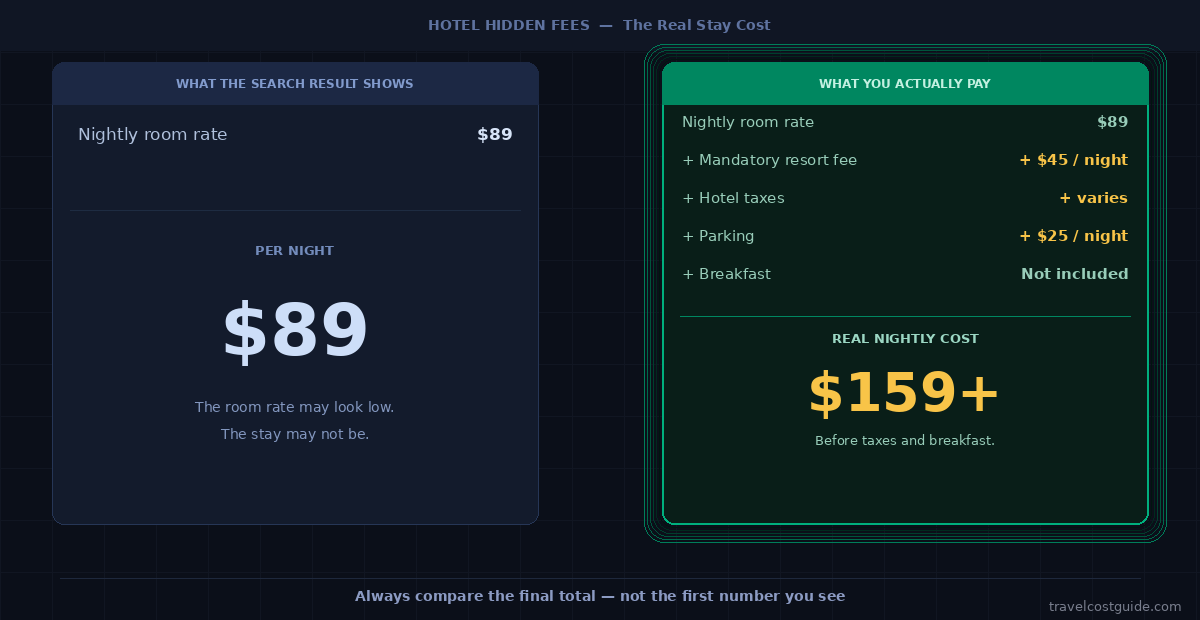
A hotel can look like an $89-a-night deal and still cost much more once mandatory fees are added. For example, a $45 nightly resort fee on a four-night stay adds $180 before you even consider taxes, parking, breakfast, or cancellation risk. The room rate may look low. The stay may not be.
The room rate is not always the room cost.
A hotel can look affordable in search results and become significantly more expensive by the final booking screen. Taxes, resort fees, destination fees, service charges, cleaning fees, deposits, parking, breakfast, and cancellation rules can all change what you actually pay — often without being visible until you’re deep into checkout.
This is the next step after understanding hidden flight costs. Once you know what your flight really costs, the next major number to verify is the full cost of where you’ll sleep. By the end of this guide, you’ll know how to run a complete hotel cost comparison — nightly rate and everything underneath it.
Last updated: May 2026. Hotel fees, taxes, cancellation rules, and pricing display requirements can change. Always confirm final terms directly with the hotel, booking platform, or relevant consumer protection authority before booking.
How this guide was prepared: This guide focuses on practical pre-booking checks travelers can use before paying for a hotel, vacation rental, or short-term stay. It uses official consumer protection resources, booking platform pricing documentation, and hotel payment policy examples as reference points. Lodging fees vary by country, city, property, booking platform, loyalty status, room type, and cancellation policy — always verify the final total before purchase.
1. The Nightly Rate Is Not the Final Price
The most common hotel booking mistake is comparing properties by nightly rate alone.
A room listed at $130 per night may not really cost $130 per night once taxes and mandatory fees are added. Another room listed at $150 per night may be cheaper overall if it has fewer mandatory charges, or if it includes breakfast, parking, or a more flexible cancellation policy. In some destinations, taxes and fees alone can add 25–40% to the advertised nightly rate — meaning a $130 room can easily become $162–$182 before any optional extras.
Before deciding that one hotel is cheaper than another, click far enough into the booking flow to see the actual total. Don’t compare the first number you see in search results. Compare the total amount you’re expected to pay for the full stay.
For U.S. short-term lodging, the FTC’s Rule on Unfair or Deceptive Fees requires covered businesses to clearly disclose total prices including mandatory fees. The rule covers many but not all booking platforms, and does not apply to stays outside the U.S. Even where it applies, travelers should continue checking the final payment screen — taxes, refundable deposits, optional services, and property-specific charges can still appear differently depending on where and how the booking is made.
💡 Quick Rule: Never compare “nightly rate vs. nightly rate.” Always compare final total vs. final total — same dates, same room type, same cancellation policy.
2. Hotel Taxes and Fees Can Change the Final Price
Taxes are one of the biggest reasons a hotel price changes between the search result and the final booking page — and they vary dramatically by destination.
Hotel tax structures vary widely by destination. Amsterdam lists a tourist tax based on a percentage of the overnight price excluding VAT. Paris applies a taxe de séjour that varies by accommodation category. New York City hotel stays can include several separate charges, including hotel room occupancy tax, New York State sales tax, New York City sales tax, and a New York State hotel unit fee. In other destinations, VAT or GST may be included in the displayed price or appear separately in the final breakdown.
Depending on the destination, you may encounter:
- Occupancy or room tax
- City or municipal tax
- Tourist tax
- VAT or GST
- Local accommodation levy
- Government-imposed lodging charges
Some taxes are included in the displayed price. Others appear separately before payment or are collected at the property on arrival. This depends on the booking platform, country, city, and property type — and the difference isn’t always obvious until you’re at checkout.
Mandatory hotel fees can also appear under names such as resort fee, destination fee, facility fee, amenity fee, or service charge. These may cover bundled amenities — Wi-Fi, pool access, fitness center use, bottled water, or other property services. These fees are widely charged across the U.S. and many international destinations, though consumer advocacy groups continue to debate their transparency and disclosure requirements. Regardless of the name or justification, if every guest must pay it, treat it as part of the room cost.
3. Resort Fees and Destination Fees: The Costs That Add Up Fastest
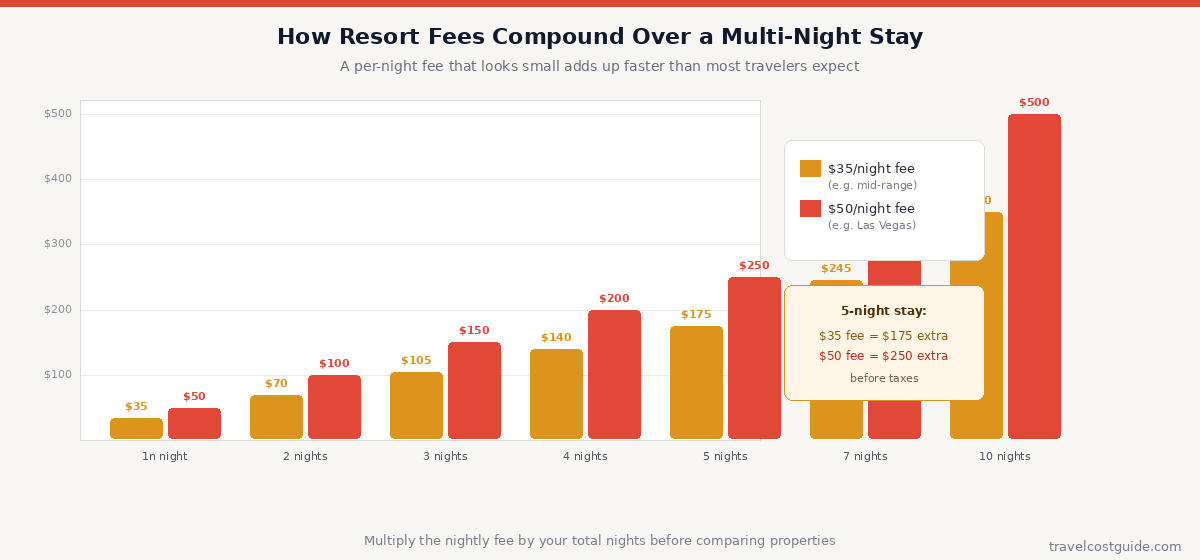
Resort fees and destination fees deserve special attention because they’re charged per night — which means they compound across the full stay.
A $35 nightly destination fee doesn’t look dramatic on its own. On a five-night stay, it adds $175 before tax. In Las Vegas, mandatory resort fees at major properties often run $30–$50 per night — meaning a five-night stay can carry $150–$250 in fees on top of a booking that appeared much cheaper in the original search result.
Before booking a property with a resort or destination fee, check:
- Is the fee mandatory for all guests?
- Is it charged per room or per person?
- Is it charged per night or once per stay?
- Is it taxed on top of the base rate?
- What does the fee include?
- Would you actually use those included amenities?
If the fee covers amenities you’d use regardless — gym, Wi-Fi, pool — it may represent reasonable value. If it covers services you won’t use, it’s still part of the total cost and must be included in your comparison.
💡 How to check resort fees before booking: Search the hotel name plus “resort fee” before committing. Start with the final booking screen and the hotel’s official website, then cross-check recent guest reviews, booking platform price breakdowns, and reputable fee-tracking resources if needed.
4. Cleaning Fees and Service Fees Hit Short Stays Hardest
Cleaning fees are common in vacation rentals and some short-term stays. They’re typically charged once per booking — which means they affect short stays far more heavily than long ones.
A $90 cleaning fee on a six-night stay adds $15 per night. The same $90 cleaning fee on a two-night stay adds $45 per night. That single line item can flip whether a vacation rental is actually cheaper than a hotel for the same dates.
For example, a two-night rental that appears $30 cheaper per night than a nearby hotel can still cost more overall. After an $85 cleaning fee, a $22 service fee, and local taxes, that rental could easily run $60 more for the weekend than the hotel it seemed to beat.
Before booking a rental or serviced apartment, check:
- Cleaning fee (one-time or per night?)
- Service or platform fee
- Extra guest charge
- Pet fee
- Linen or management fee
- Local taxes
- Whether each fee is refundable if you cancel
Similar fee structures apply on platforms including Airbnb, VRBO, and other short-term rental sites — always check the full price breakdown specific to your booking before confirming, as fees vary by host and listing even on the same platform.
💡 Short-stay rule: For stays of one or two nights, always calculate the full rental cost including all fixed fees before comparing it to a hotel. The nightly rate alone is almost meaningless for short rentals.
5. Deposits and Card Holds Affect Your Available Budget
A deposit or card authorization hold is different from a fee — but it can still affect your travel budget in ways that matter.
Many hotels require a credit or debit card to guarantee the reservation. Some rates are charged at booking, particularly advance purchase rates or bookings requiring a deposit. At check-in, properties may also place a temporary hold for room, tax, resort fees, and incidentals.
This hold reduces your available credit. If you use a debit card, it may reduce your available cash until the bank releases the hold, which can take several business days or longer depending on the hotel, card issuer, bank, and country. A credit card may be more practical for some travelers because the hold usually affects available credit rather than cash in a bank account, but you should confirm your own card terms before relying on it.
Before booking or checking in, confirm:
- Is a deposit required — and is it refundable?
- When is it charged?
- Will the hotel place an incidental hold at check-in?
- How large is the hold per night or per stay?
- How long can the hold take to release after checkout?
- Should you use a credit or debit card for this booking?
💡 Practical Rule: A hold is not always a final charge, but you still need enough available funds to travel comfortably while it is pending. Before check-in, ask the hotel how much it may authorize and whether a credit or debit card is better for your situation.
6. Breakfast, Parking, Wi-Fi, and Extra Guests Can Flip the Comparison
Some hotel costs aren’t hidden. They’re just easy to leave out of the comparison.
Breakfast is the clearest example. A hotel that includes breakfast for two travelers may be $30 more per night — but if breakfast for two at a nearby café costs $25, the included-breakfast hotel is actually $20/night cheaper once you run the full number. Parking works the same way: a budget hotel charging $30/night for parking next to a slightly more expensive hotel with free parking isn’t cheaper once you’re driving.
For work travelers or digital nomads, free Wi-Fi listed in amenities doesn’t always mean fast or reliable Wi-Fi — checking recent guest reviews specifically mentioning Wi-Fi speed is often more useful than what the listing says. Location matters too: a hotel 40 minutes from the city center may save $30/night but cost more in daily transport if you’re making repeated trips — always factor that into the full comparison.
Check whether these are included or extra before comparing final costs:
- Breakfast (for how many guests?)
- Parking (per night or per stay?)
- Wi-Fi (in-room vs. lobby only? Speed?)
- Extra guest charge
- Rollaway bed or crib
- Pet fee
- Gym, pool, spa, or facility access
- Early check-in or late checkout
- Luggage storage
The best hotel isn’t always the one with the lowest nightly rate. It’s the one with the best total cost for the way you actually travel.
7. Cancellation Rules Are Part of the Real Cost
A non-refundable room is a fine choice when the trip goes exactly as planned. It becomes an expensive one when dates shift, flights change, a visa is delayed, a work conflict appears, or someone gets sick.
Before booking, review the cancellation policy carefully. Pay attention to the deadline, the time zone it’s set in, whether only the first night is charged after the deadline or the full stay becomes non-refundable, and whether taxes and fees are refundable at all.
Check these before choosing a cheaper non-refundable rate:
- What is the free cancellation deadline?
- What time zone controls that deadline?
- Is the first night charged — or the full stay?
- Are taxes and fees refundable on cancellation?
- Does the booking platform have different rules from the hotel directly?
- Who handles changes if you booked through a third-party site?
Note that in extraordinary circumstances — natural disasters, government travel restrictions, or similar force majeure events — standard cancellation policies may be applied, modified, or waived differently by the property or platform. This is not guaranteed. Check the platform’s extenuating circumstances policy in addition to the standard cancellation terms, and don’t assume unusual events will automatically result in a refund on a non-refundable booking.
If your trip depends on flights, visas, events, weather, health, or work schedules, this is also where trip cancellation coverage may be worth reviewing. Some policies may reimburse certain non-refundable prepaid costs if you cancel for a covered reason, but coverage, exclusions, documentation rules, and claim limits vary by policy.
8. A Simple Hotel Cost Comparison
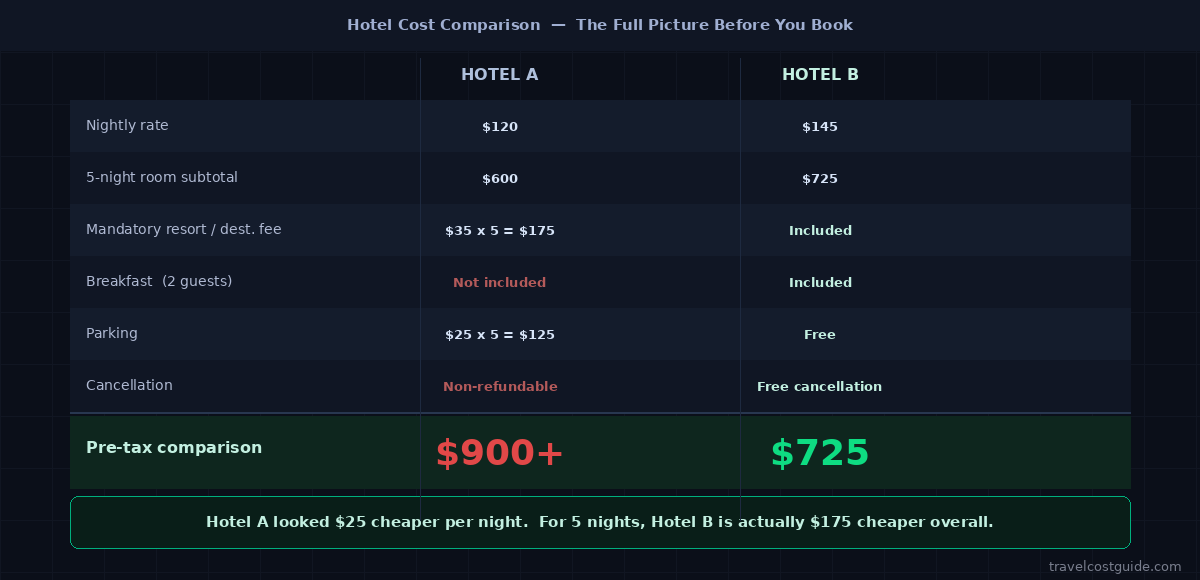
Here’s how two hotels that look different in search results can reverse completely when you compare the full cost.
| Cost Item | Hotel A | Hotel B |
|---|---|---|
| Nightly rate | $120 | $145 |
| 5-night room subtotal | $600 | $725 |
| Mandatory resort / destination fee | $35 × 5 = $175 | Included |
| Breakfast (2 guests) | Not included | Included |
| Parking | $25 × 5 = $125 | Free |
| Cancellation flexibility | Non-refundable | Free cancellation |
| Pre-tax comparison | $900 + breakfast cost | $725 |
Hotel A looked $25 cheaper per night — $125 less for the 5-night stay. After mandatory fees and parking, Hotel B is actually $175 cheaper for the full stay — before factoring in breakfast or cancellation flexibility. If plans shift and you need to cancel after the deadline, Hotel A’s non-refundable rate means up to $900 lost. Hotel B’s free cancellation means $0 lost.
Note: taxes are not included in this comparison. Depending on destination, applicable taxes can add $80–$200 or more to the totals above.
Where to Verify Hotel Fees Before Booking
Because hotel fees vary by country, city, property, and booking channel, don’t rely only on the first search result. Verify from primary sources before paying:
- Final booking screen — confirm total price after taxes, mandatory fees, and service charges
- Hotel’s official website — compare the same room, dates, cancellation policy, and included benefits
- Booking platform price breakdown — check what’s included, excluded, conditional, or paid at property
- Cancellation policy — review deadlines, time zones, refundability, and no-show rules
- Deposit and card hold policy — check whether a deposit or incidental authorization hold is required
- Recent guest reviews — search reviews mentioning “resort fee,” “destination fee,” or “charged at check-in” for real-world confirmation
- Official consumer resources: For U.S. short-term lodging, review the FTC Rule on Unfair or Deceptive Fees FAQ
- Platform fee guidance: For vacation rentals, review Airbnb cleaning fee guidance and Airbnb service fee guidance
- Booking.com charge types: For a practical explanation of how hotel charges can be included, excluded, conditional, or mandatory within a booking flow, review Booking.com extra charge documentation
Frequently Asked Questions
Are resort fees always mandatory?
If a resort fee, destination fee, facility fee, or amenity fee is listed as mandatory for the stay, it is part of the room cost regardless of what it’s called or whether you use the included amenities. Whether it’s displayed upfront depends on the property, platform, jurisdiction, and applicable pricing rules.
What exactly is a resort fee — and why do I have to pay it?
A resort fee is a mandatory per-night charge added by some hotels on top of the room rate. It may bundle amenities such as pool access, Wi-Fi, gym use, bottled water, or local services. If the fee is mandatory, treat it as part of the stay cost whether or not you use the included amenities. Disclosure requirements vary by jurisdiction, property, and booking channel.
How much can hotel taxes and fees add to the total?
It varies significantly by destination. In high-tax cities — Amsterdam, Paris, New York, Las Vegas resort properties — total taxes and fees can add 20–40% on top of the advertised nightly rate. The only reliable way to know is to check the final total at checkout before confirming.
Is a vacation rental cheaper than a hotel?
Sometimes — but not always, especially for short stays. Vacation rentals often have lower nightly rates but add significant fixed costs: cleaning fees, service fees, and local taxes. For a two-night stay, a $90 cleaning fee alone adds $45 per night. For stays of five nights or more, rentals can be genuinely cheaper than equivalent hotels. For one or two nights, run the full cost comparison including all fixed fees before deciding.
Are hotel deposits the same as hotel fees?
No. A deposit or authorization hold may be temporary, while a fee is part of what you pay. However, deposits and card holds can still reduce your available funds during the trip, especially if you use a debit card. Release timing varies by hotel, bank, card issuer, payment method, and country.
Are cleaning fees refundable if I cancel?
It depends on the platform, property, timing, and cancellation policy. Some platforms refund cleaning fees on cancellations before check-in; others don’t. Always check the specific refund breakdown for your booking before canceling.
Should I book directly with the hotel or through a booking platform?
There’s no universal answer. Booking directly may simplify changes, loyalty points, and direct communication. Booking through a platform may offer comparison tools, pricing transparency, or package rates. Compare the same room, same dates, same cancellation terms, and same final total before deciding.
How do I know if a hotel is actually cheaper?
Compare the full stay cost — not the nightly rate. Add all mandatory fees, taxes, parking, breakfast, deposit requirements, and the value of cancellation flexibility. The hotel with the lowest final total for the way you travel is the cheaper option.
The Hotel Cost Checklist
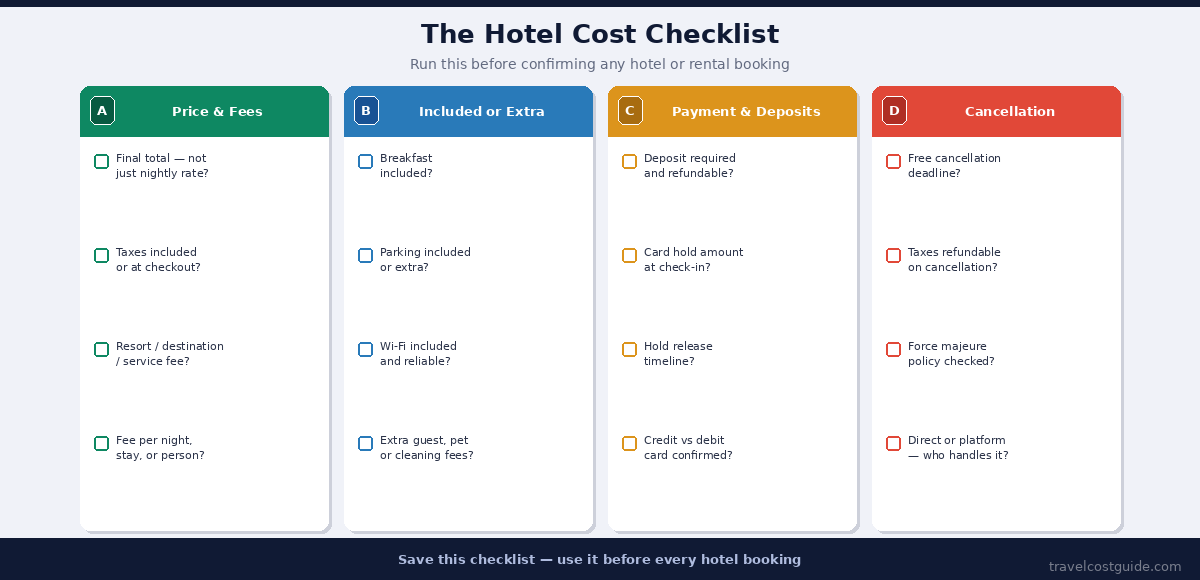
Before confirming any hotel or rental booking, run through this:
Price & Fees
- Final total confirmed — not just nightly rate?
- Taxes included or added at checkout?
- Resort, destination, facility, or service fee?
- Fee charged per night, per stay, per room, or per person?
Included or Extra
- Breakfast included?
- Parking included or extra?
- Wi-Fi included — and reliable?
- Extra guest, pet, cleaning, or service fees?
Payment & Deposits
- Deposit or incidental hold required?
- Credit vs. debit card impact confirmed with your card issuer?
- Hold release timeline checked with the hotel?
Cancellation
- Free cancellation deadline confirmed?
- Taxes and fees refundable on cancellation?
- Force majeure / extenuating circumstances policy checked?
- Booked direct or through a platform — who handles changes?
The Bottom Line
Hotel fees aren’t always hidden because someone’s trying to trick you. Many are taxes, local charges, platform fees, or optional services. The problem is that travelers often compare the wrong number — and don’t find out until check-in.
The fix is simple: compare the full stay cost. Add taxes, mandatory fees, cleaning fees, parking, breakfast, deposit requirements, and cancellation risk before deciding which property is cheaper. A hotel that looks $25 cheaper per night can easily cost $200 more for the stay once the full picture is in.
Now that you know the real cost of your flight and hotel, the next layer is how you pay. Even when the booking price looks settled, your card, currency choice, and foreign transaction fees can still change what you actually pay.
Read next: How to Avoid Foreign Transaction Fees Abroad →
The hotel with the lowest rate isn’t always the hotel with the lowest cost. Now you know how to tell the difference.