

You land. Your phone buzzes.
International data charges have been applied to your account.
The trip hasn’t started — and the extra costs already have.
This is the moment most travelers realize they should have sorted out their connectivity plan before departure. The options seem simple: get a travel eSIM or let your regular carrier handle it. In practice, the better choice depends on your phone, your carrier, your destination, your data habits, and whether you need calls, texts, or banking verification codes while you’re abroad.
This guide compares eSIM vs international roaming from a practical travel cost perspective. It does not recommend a specific eSIM provider, carrier, or travel package. The goal is to explain the cost layers so you can choose the right setup for your trip — before you land.
How this guide was prepared: This comparison was developed using publicly available information from device manufacturers, carrier support pages, and consumer protection agencies. No eSIM provider, carrier, or travel product has sponsored or influenced this content. Cost figures used as examples are illustrative only and do not reflect current pricing from any specific provider.
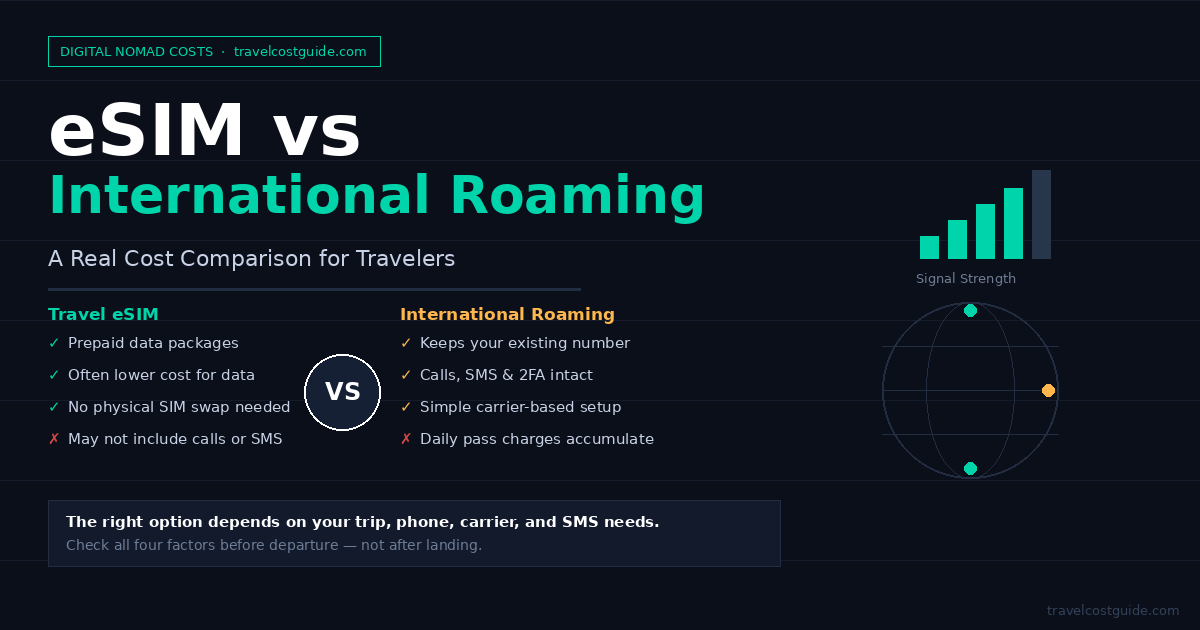
eSIM vs International Roaming: The Basic Difference
An eSIM is a digital SIM profile built into a compatible phone. Instead of inserting a physical card, you download or activate a mobile plan digitally. For travel, many eSIM plans are sold as prepaid data packages for a specific country, region, or multi-country zone.
International roaming means your home carrier allows your phone to connect to a partner network abroad. Depending on your plan, this may work as a daily roaming pass, a monthly travel add-on, included travel data, or pay-per-use charges. Some plans include roaming automatically. Others require activation before departure.
The cost difference isn’t only about the advertised price. A travel eSIM may offer affordable data, but many plans don’t include a local phone number, traditional voice calls, or SMS. Roaming may cost more per day, but it often keeps your existing number active for calls, texts, two-factor authentication codes, and alerts that your banking and work apps depend on.
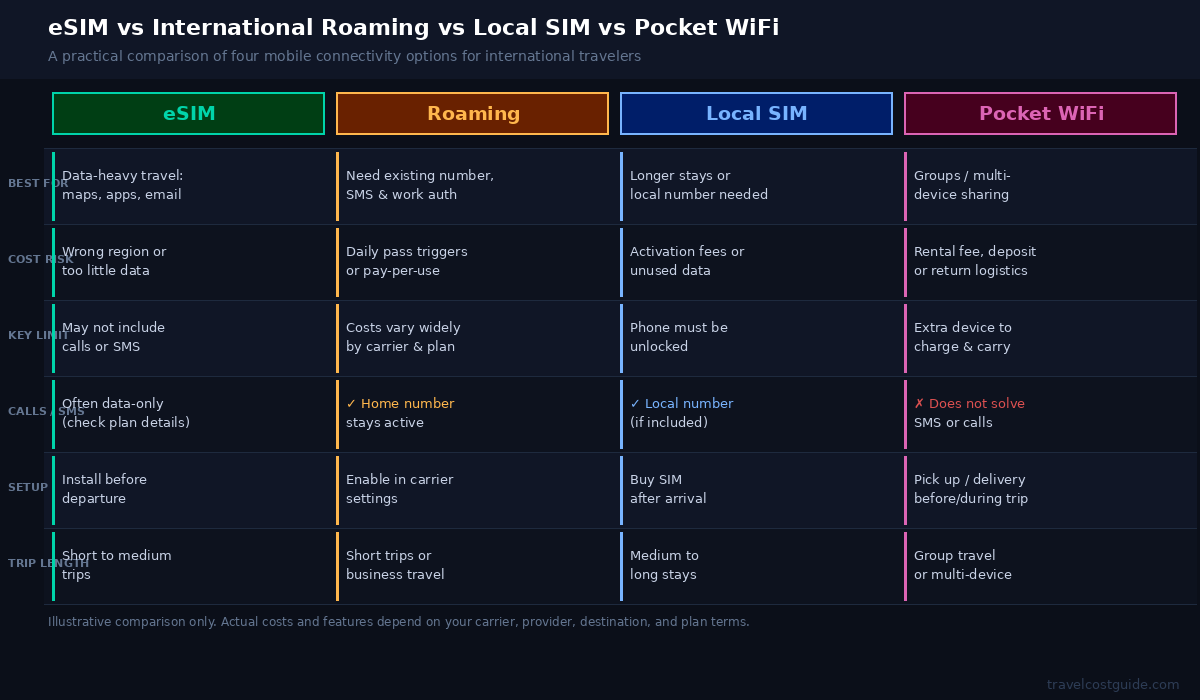
| Option | Usually Best For | Main Cost Risk | Key Limitation |
|---|---|---|---|
| Travel eSIM | Data-heavy travelers: maps, messaging, email, ride apps, translation | Buying too little data, wrong region coverage, or leaving your home SIM roaming in the background | Many travel eSIMs are data-focused and may not include traditional calls or SMS |
| International roaming | Travelers who need their existing number, SMS, voice calls, or work verification active | Daily pass triggers, pay-per-use rates, background data use, or plan exclusions for certain destinations | Costs vary widely by carrier, destination, plan type, and usage rules |
| Local physical SIM | Longer stays, local number needs, or travelers who can easily buy a SIM after arrival | Activation fees, ID requirements, tourist SIM pricing, or unused data allowance | Phone must be carrier-unlocked; may require removing your home SIM |
| Pocket WiFi | Groups, families, or travelers sharing one data connection across multiple devices | Rental fees, deposit, loss fee, pickup and return logistics | Adds a device to charge and carry; does not replace phone number or SMS access |
Why eSIM Plans Often Look Cheaper
Travel eSIM plans can look cheaper because many are prepaid and data-focused. You set a fixed data amount before departure, install the profile digitally, and use it from arrival. That predictability makes it easier to estimate costs compared to open-ended pay-per-use roaming charges.
For travelers who mainly need maps, messaging apps, email, browser access, translation tools, and ride-hailing apps, a data-only plan may cover most of what they need. If most communication happens through internet-based apps, traditional voice minutes and SMS may not be essential for everyday use.
Cheaper doesn’t always mean simpler, though. Before buying any travel eSIM, check four things:
- whether your exact phone model supports eSIM;
- whether your phone is carrier-unlocked for other mobile plans;
- whether the plan covers your specific destination or travel region;
- whether the data allowance reflects your real daily usage, not just a minimum estimate.
A low-cost eSIM can become a problem in a different way if it doesn’t activate correctly, if your phone is locked to your home carrier, if your destination isn’t covered, or if you still need SMS messages on your home number for banking logins, work authentication, or account verification.
Why International Roaming Can Still Make Sense
International roaming gets a reputation for being expensive — and in some cases, it is. Daily pass charges, pay-per-use rates, fair-use limits, and separate rules for cruise ships, airplanes, or specific partner networks can all add to the total.
But for certain travelers, roaming is simply the more practical choice. Short trip. No time to manage dual SIM settings at the gate. Need your existing number active for client calls, SMS codes, banking alerts, or family emergencies.
That convenience has real value — especially on a business trip where someone needs to reach you by your normal number, or for travelers who aren’t comfortable adjusting cellular network settings in a foreign airport.
The key is understanding what triggers a charge on your plan. On some plans, a daily roaming pass may activate when you use data, send a text, make or receive a call, or when background app data connects abroad. On others, charges may be pay-per-use. Your carrier’s official travel or roaming page is one of the most important sources to check — before departure, not after your first notification abroad.
A Real Cost Comparison: Four Travel Scenarios
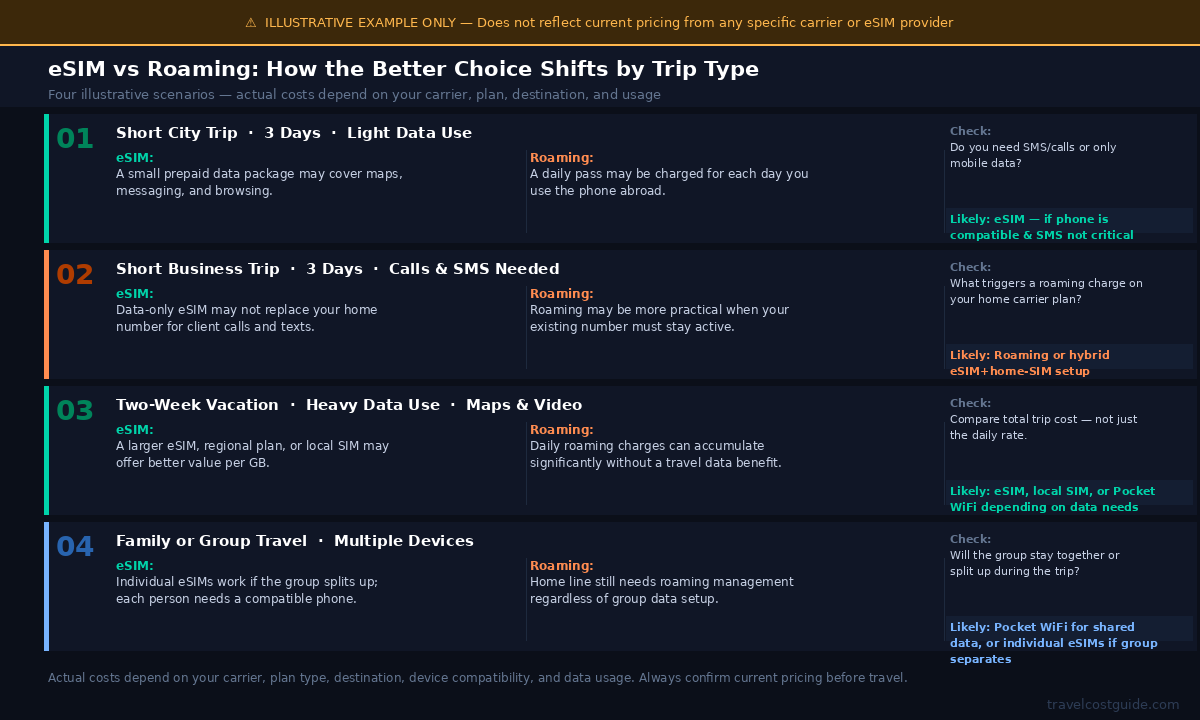
Instead of asking which option is cheaper in general, compare the total cost for your specific trip. The scenarios below show how the better choice shifts depending on how you travel — not just the advertised price.
⚠️ Illustrative example only: The scenarios below do not reflect current prices from any specific carrier or eSIM provider. Actual costs depend on your carrier, plan type, destination, device, and usage. Always confirm current pricing with your provider before travel.
| Travel Situation | Travel eSIM Example | Roaming Pass Example | What to Check First |
|---|---|---|---|
| 3-day trip, light data use | A small prepaid data package may cover maps, messaging, and basic browsing for the trip. | A daily roaming pass may be charged for each day the phone uses service abroad. | Do you need SMS and calls, or only mobile data? |
| 7-day trip, moderate data use | A country or regional plan may offer predictable cost for data-only needs over the week. | Daily charges accumulate over a week unless travel benefits are already included in your plan. | Check data caps, speed throttling thresholds, and hotspot rules. |
| Business trip with calls and SMS | A data-only eSIM may not replace your home number for client calls and verification texts. | Roaming may be more practical when your existing number needs to stay fully active. | What exactly triggers a roaming charge on your home carrier plan? |
| Two-week trip, heavy data use | A larger country eSIM, regional plan, or local SIM may offer better value per GB of data. | Daily roaming charges can become significant over a longer trip without an included travel data benefit. | Compare the total cost over the full trip, not just the daily rate. |
Illustrative example only. Actual costs depend on your carrier, plan, destination, and data usage. Always confirm current pricing with your provider before travel.
Scenario 1: Short City Trip, Light Data Use
Three days. Maps, restaurant searches, messaging apps, a few ride-hailing trips. No urgent client calls. Most verification codes set up before departure through an authenticator app.
A small prepaid travel eSIM may be cost-effective here — you only need a modest amount of data. A daily roaming pass could cost more than a small prepaid package if the pass is triggered for each day you use the phone abroad.
Likely better fit: eSIM, if your phone is compatible and you don’t need regular SMS or voice calls during the trip.
Scenario 2: Short Business Trip With Calls and SMS
Three days. Client calls expected. SMS authentication codes from the banking app. Work login messages. Fraud alerts from the card issuer. You also need data for maps, email, and messaging throughout the day.
Roaming may be more practical here, even if the daily charge is higher. A data-only eSIM covers internet use, but it may not keep your home number available for normal calls and texts. You could run both — eSIM for data, home SIM for calls and SMS. But that setup requires careful dual SIM configuration to avoid accidental roaming charges on the home line.
Likely better fit: roaming, or a hybrid eSIM-plus-home-SIM setup depending on how critical your home number is during the trip.
Scenario 3: Two-Week Vacation, Heavy Data Use
Daily roaming passes can become expensive over two weeks. A traveler using maps, video calls, social uploads, translation apps, and mobile hotspot for a laptop may consume data far faster than expected. In this case, a larger travel eSIM, regional plan, local SIM, or Pocket WiFi may all be worth comparing side by side.
The cheapest advertised data package isn’t automatically the best choice. Check hotspot rules, speed throttling after a data threshold, daily caps, and whether customer support is reachable if activation fails after arrival.
Likely better fit: eSIM, local SIM, or Pocket WiFi — depending on data needs, group size, and how much you need your home number active.
Scenario 4: Family or Group Travel
Multiple people. Multiple devices. One shared connection can look attractive.
Pocket WiFi allows one device to share data across phones, tablets, and laptops — useful for families or small groups. The tradeoff is logistics: it needs to be charged, carried, and returned at the end of the trip. If the group separates at any point, only the person with the device has that shared connection. It also doesn’t replace SMS or normal phone service on anyone’s home number.
Likely better fit: Pocket WiFi for shared data, or individual eSIMs if the group plans to split up frequently.
What a Data-Only eSIM May Not Cover
Many travel eSIM plans are designed primarily for mobile data. Depending on the provider and plan, they may not include a traditional phone number, standard SMS, or regular cellular voice calls.
This matters more than most travelers expect. Several situations abroad still depend on your phone number — not your internet connection:
- banking verification codes;
- credit card fraud alerts;
- airline and hotel SMS updates;
- work account two-factor authentication;
- ride-hailing driver calls in some destinations;
- restaurant reservations that ask for a contact number;
- emergency contact from family or colleagues.
If you rely on SMS-based verification for banking, work accounts, or email recovery, don’t assume a data-only travel eSIM will replace your home mobile line. Before departure, check whether your bank, card issuer, email provider, and work systems support app-based authentication, authenticator apps, email verification, or backup codes.
💡 Check before you leave: Log into your bank app, credit card app, and any work systems you’ll need abroad. Verify that each one can authenticate without SMS if needed — through an authenticator app, email, or backup codes. If SMS is the only option for any account, your home line may need to stay active during the trip.
Device Compatibility and Dual SIM Settings
Not every phone can use every eSIM. Compatibility depends on your phone model, operating system version, the region where the device was sold, your carrier’s support settings, and whether the phone is carrier-locked.
Before buying any travel eSIM, confirm the following:
- eSIM support: confirm your exact phone model supports eSIM — not all devices in the same product line do;
- Carrier lock status: confirm your phone can activate a plan from another carrier or travel provider — this is especially important for carrier-subsidized phones common in the US market;
- Destination coverage: verify the plan covers the specific countries or regions you’ll visit;
- Activation timing: check whether the plan starts immediately after installation or only after first connecting to a network abroad;
- Network bands: for older or imported phones, confirm the device supports local frequency bands at your destination;
- Hotspot use: confirm whether tethering is allowed under your plan if you need to connect a laptop or second device.
Once you’ve bought the eSIM, the next step is the part travelers most often miss: the phone settings.
When you add a travel eSIM while keeping your home SIM active, your phone has two lines running. That can be useful. It can also create unexpected charges if the phone uses the wrong line for data, calls, or background app activity. Before departure or immediately after landing, review these settings:
- which line is set as the mobile data line;
- whether data roaming is enabled only for the travel eSIM line;
- whether automatic data switching is on — this can route data through the home line if the eSIM signal drops;
- which line handles calls and SMS;
- whether background app refresh, cloud backup, and automatic downloads are restricted on mobile data.
A common assumption: “I bought an eSIM, so roaming is solved.” That may not be true.
If your home SIM stays active and your phone connects to a foreign network, your carrier may apply roaming charges depending on your plan and usage. Charges may be related to data use, calls, texts, voicemail, or other roaming activity, so check your carrier’s rules before travel. This can happen even when you’re using a travel eSIM for your main data. To reduce this risk, check your carrier’s roaming rules and review the data roaming settings for your home line before or immediately after landing.
Consumer guidance from telecom regulators recommends checking international roaming rates and provider rules before using a mobile phone abroad, because charges and protections can vary by carrier and destination.
To reduce this risk, travelers commonly consider one of these approaches:
- turn off data roaming specifically for the home line;
- set the travel eSIM as the mobile data line;
- disable data switching if the phone might fall back to the home line;
- keep the home SIM on only for SMS or calls — not for data;
- ask your carrier how incoming SMS, voicemail, and unanswered calls are billed when your phone is abroad.
Other Options: Local SIM, Pocket WiFi, and Hotspot Use
If eSIM and roaming don’t fit your trip, three other options are worth comparing.
Local physical SIM can be a strong option for longer stays. In some destinations, tourist SIMs are easy to buy at airports, convenience stores, or carrier shops. In others, registration requirements, ID checks, or language barriers can make the process less convenient. Your phone generally needs to be carrier-unlocked, and if it has only one physical SIM slot, inserting a local SIM may mean removing your home SIM entirely — unless your phone also supports eSIM.
Pocket WiFi is a portable router that shares a mobile data connection over Wi-Fi. It can work well for groups or travelers with multiple devices. The tradeoff is an extra device to charge, carry, and return. If the battery runs out or it gets lost, connectivity goes with it. It also doesn’t solve the phone number or SMS problem — your home SIM settings still need attention separately.
Hotspot use can change the cost comparison quickly. A traveler using mobile data only on one phone may need far less data than a traveler connecting a laptop or second device. Before choosing any plan, check whether hotspot or tethering is allowed, and whether data speeds slow after a certain amount of usage. Video calls, file uploads, cloud backups, and map downloads can use data much faster than messaging apps and basic browsing.
Travel Payment Costs Still Matter
Staying connected is one piece of international travel costs. Even when your data plan is sorted, payment fees can add up separately — every time you use an ATM, pay by card, or withdraw local currency.
If you plan to use ATMs during your trip, the fees can be more layered than they first appear. Our guide to ATM Fees Abroad: What Travelers Should Check Before Withdrawing Cash explains the multiple fee layers — including bank charges, ATM operator fees, currency conversion screens, and withdrawal limits — that can affect every cash transaction overseas.
For payment card costs more broadly, How to Avoid Foreign Transaction Fees Abroad covers the difference between foreign transaction fees, currency conversion, and dynamic currency conversion — three separate cost layers that can affect every card payment you make in a foreign currency.
Pre-Travel Connectivity Checklist
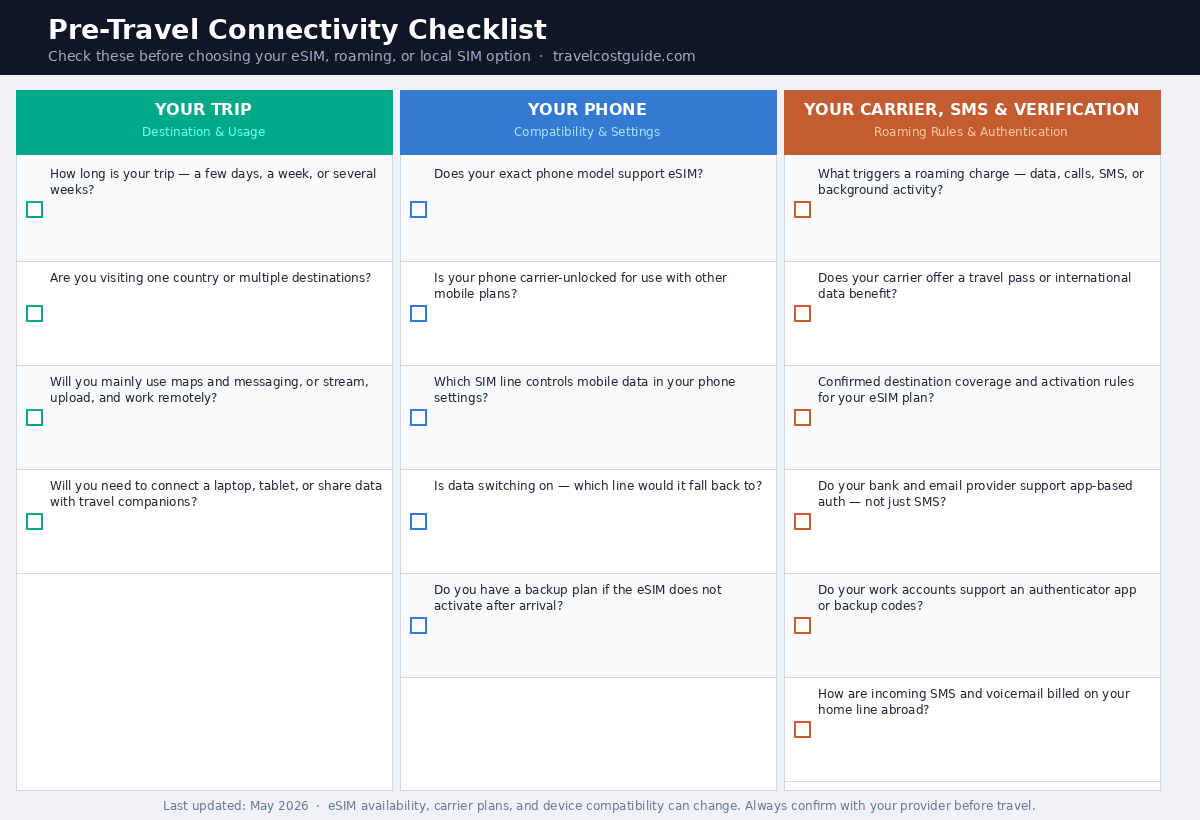
Use this checklist before choosing a mobile connectivity option for your trip.
Your Trip
- ☐ How long is your trip — a few days, a week, or several weeks?
- ☐ Are you visiting one country or multiple destinations?
- ☐ Will you mainly use maps and messaging, or do you plan to stream, upload, and work remotely?
- ☐ Will you need to connect a laptop, tablet, or share data with travel companions?
Your Phone
- ☐ Does your exact phone model support eSIM?
- ☐ Is your phone carrier-unlocked for use with other mobile plans?
- ☐ Have you confirmed which SIM line controls mobile data in your phone settings?
- ☐ Have you checked whether data switching is on and which line it would fall back to?
- ☐ Do you have a backup plan if the eSIM doesn’t activate after arrival?
Your Carrier, SMS, and Verification
- ☐ What triggers a roaming charge on your home carrier plan — data, calls, SMS, or background activity?
- ☐ Does your carrier offer a travel pass or international data benefit for this destination?
- ☐ Have you confirmed the destination coverage and activation rules for any eSIM plan you’re considering?
- ☐ Do your bank, card issuer, and email provider support app-based or email authentication — not just SMS?
- ☐ Do your work accounts support an authenticator app or backup codes?
- ☐ Have you confirmed how incoming SMS and voicemail are billed on your home line while abroad?
Frequently Asked Questions
Is an eSIM cheaper than international roaming?
It depends on your carrier, destination, and how you use your phone. Travel eSIM plans can cost less for data-only use because many are prepaid with a fixed data amount. International roaming may cost more per day, but it often keeps your existing number active for calls, texts, and verification codes. Neither option is automatically cheaper — the better value depends on what you need for your specific trip.
Does a travel eSIM work for calls and texts, or only data?
Many travel eSIM plans are data-only. They provide mobile internet access but may not include a traditional phone number, standard SMS, or regular voice calls. Some providers offer plans that include a local number or calling minutes, but this varies by provider and destination. Check the plan details carefully before purchasing if calls and SMS are important for your trip.
What happens to my regular phone number when I use a travel eSIM?
Your home number stays on your home SIM. If your phone supports dual SIM — a physical SIM and an eSIM at the same time — both lines can be active simultaneously. Your home number may still receive calls and SMS while the travel eSIM handles mobile data. The key is configuring your phone settings so the home SIM doesn’t accidentally generate roaming charges through data use.
Can I use both a travel eSIM and my home SIM at the same time?
On many dual SIM-capable phones, yes. You can set the travel eSIM as the mobile data line while keeping your home SIM available for calls and SMS. This setup can work well, but it requires reviewing your cellular settings to make sure data doesn’t route through the home line. Check your phone’s SIM management settings menu to confirm how each line is configured before and after arrival.
Do I still get charged for roaming if my home SIM is active while I’m abroad?
Possibly, yes. If your home SIM stays active and your phone connects to a foreign network, your carrier may apply roaming charges depending on your plan and usage. Charges may be related to data use, calls, texts, voicemail, or other roaming activity, so check your carrier’s rules before travel. This can happen even when you’re using a travel eSIM for your main data. To reduce this risk, check your carrier’s roaming rules and review the data roaming settings for your home line before or immediately after landing.
What should I check before buying a travel eSIM?
Confirm that your phone model supports eSIM and that it’s carrier-unlocked. Check that the plan covers your specific destination. Review the activation timing — some plans start immediately after installation, others only after first connecting to a network abroad. Confirm whether hotspot use is allowed. Check whether the plan is data-only or includes calls and SMS. And verify that your data estimate reflects your real daily usage.
Is a travel eSIM better than a local SIM card?
For short trips, a travel eSIM may be more convenient because it can be installed before departure without needing to find a carrier store after landing. For longer stays, a local physical SIM can offer better rates, more data, or a local number in some destinations. A local SIM typically requires an unlocked phone and may involve in-person registration. The better choice depends on trip length, destination, and whether you need local number access.
Bottom Line
There’s no single answer to eSIM vs international roaming. But there is a clearer question to ask.
Not: Which option is cheapest?
But: Which setup gives you the data, number access, SMS reliability, and cost control you actually need for this specific trip?
An eSIM may reduce mobile data costs for some travelers — especially for trips where maps, messaging, and browsing cover most of your connectivity needs. Roaming may cost more per day, but it can be worth the price when your existing number needs to stay active for calls, verification texts, or work alerts.
One costly outcome is paying for both — and not checking your settings before landing.
Before you travel: confirm your phone is compatible, understand what triggers your carrier’s roaming charges, check your SMS and verification needs, and review your dual SIM settings. That preparation takes less time than sorting out unexpected charges after the trip ends.
The cheapest data plan is not always the most useful one. A better setup is the one that helps you stay connected, verified, and in control — for this trip.
Where to Verify
Before choosing a mobile plan for international travel, check these official sources for current information on eSIM support, roaming rules, and consumer protections in your region:
- Apple Support: Use eSIM while traveling internationally with your iPhone
- Apple Support: Wireless carriers and worldwide providers that support eSIM
- Google Pixel Help: Get a SIM or eSIM and add it to your Pixel phone
- FCC: International Roaming — Mobile Phone Use Abroad
- Ofcom: Using your mobile abroad
Read Next
Mobile connectivity is one piece of international travel cost planning. These guides cover the payment fees and budgeting decisions that affect the rest of your trip:
- For ATM fees, withdrawal limits, and cash access costs abroad: ATM Fees Abroad: What to Check Before Withdrawing Cash →
- For foreign transaction fees, currency conversion, and card payment costs abroad: How to Avoid Foreign Transaction Fees Abroad →
- For a full international trip budget framework, including flights, hotels, payments, and connectivity: The Real Cost of an International Trip — Before You Book →
- Up next in this series: Travel Insurance Costs: What You’re Actually Paying For →
Last updated: May 2026. eSIM availability, carrier roaming plans, device compatibility, and international data pricing can change. Always confirm current terms with your carrier and eSIM provider before travel.